
 Search
 en
 English
 日本語
 русский
 Español
 Deutsch
 中文简体
Content
If a fluorescence image looks washed out, the problem is rarely the camera. More often, the filter stack is letting excitation light leak into the emission channel. That is the practical stakes behind optical glass filters: they decide which wavelengths reach your sensor or sample, and which get stopped before they can do harm. Put simply, a sound filter purchase starts with your light source and detector wavelengths, then comes down to verifying a short list of specifications—cut-on and cut-off points, blocking depth, transmission, substrate, and coating durability—against the environment the filter will actually face. This guide covers how these filters work, which types do which jobs, and what to check before committing to a supplier.
How an Optical Glass Filter Works
An optical glass filter transmits a chosen range of wavelengths and blocks the rest, either by absorbing unwanted light inside the glass itself or by reflecting it with a thin-film coating. Absorptive filters use colored glass in which metal ions or other dopants absorb unwanted wavelengths throughout the material. They are inexpensive, insensitive to the angle of incoming light, and forgiving of surface contamination, but their transmission edges are gradual.
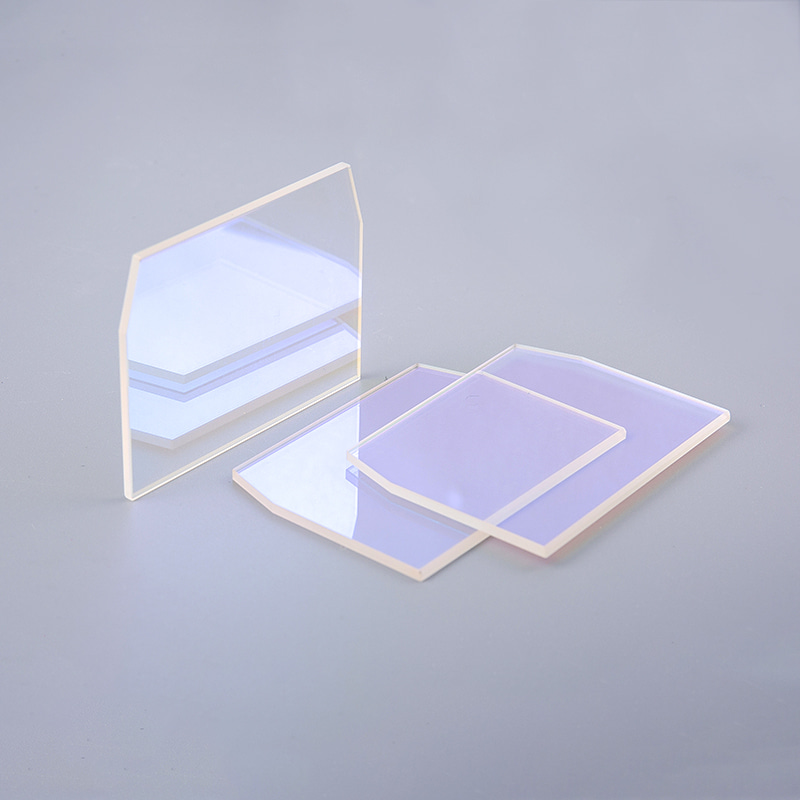
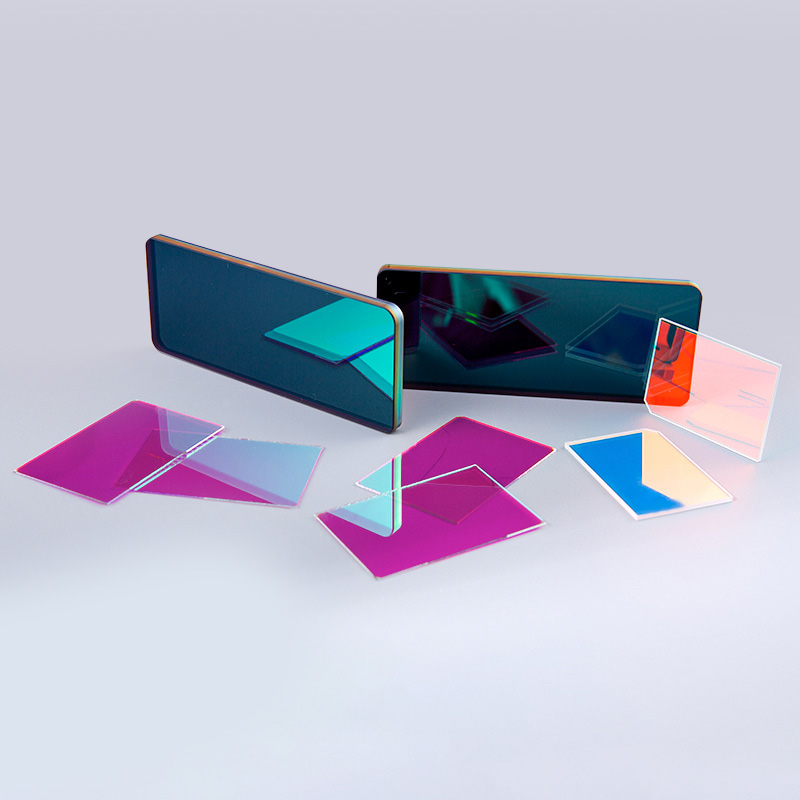
Dichroic, or interference, filters take the opposite approach. Dozens of alternating thin layers with different refractive indices are deposited on a polished substrate, and the stack is tuned so constructive interference reinforces transmission in the passband while destructive interference cancels nearly everything else. The result is a steep spectral edge, deep blocking, and precise control of the passband, at the cost of some sensitivity to angle of incidence and temperature.
Most industrial filters are hybrids: an interference coating on a high-quality colored or clear glass substrate, with the coating doing the fine spectral work and the substrate providing mechanical strength and environmental protection.
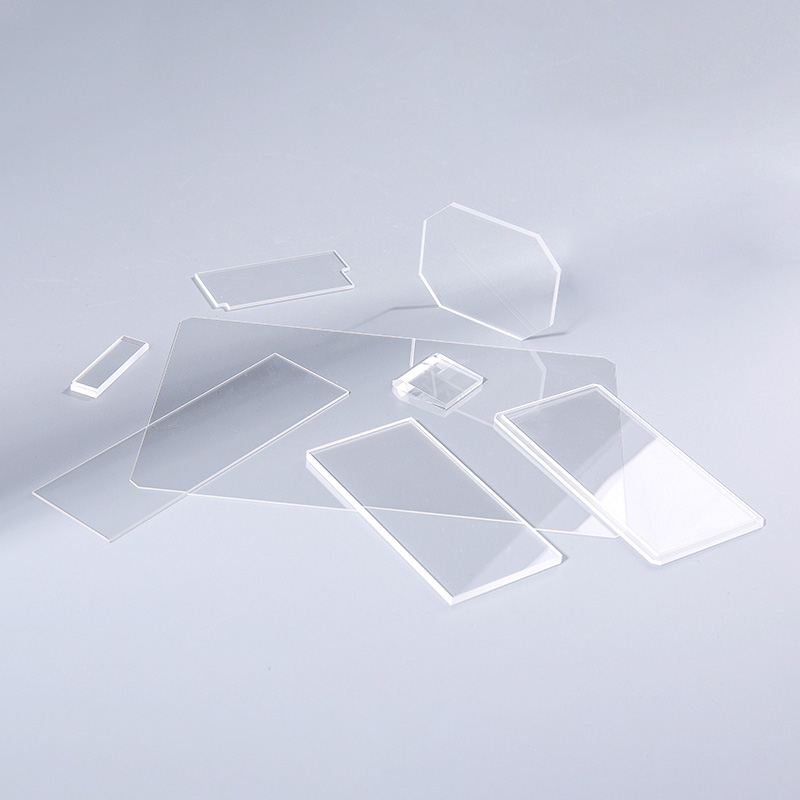
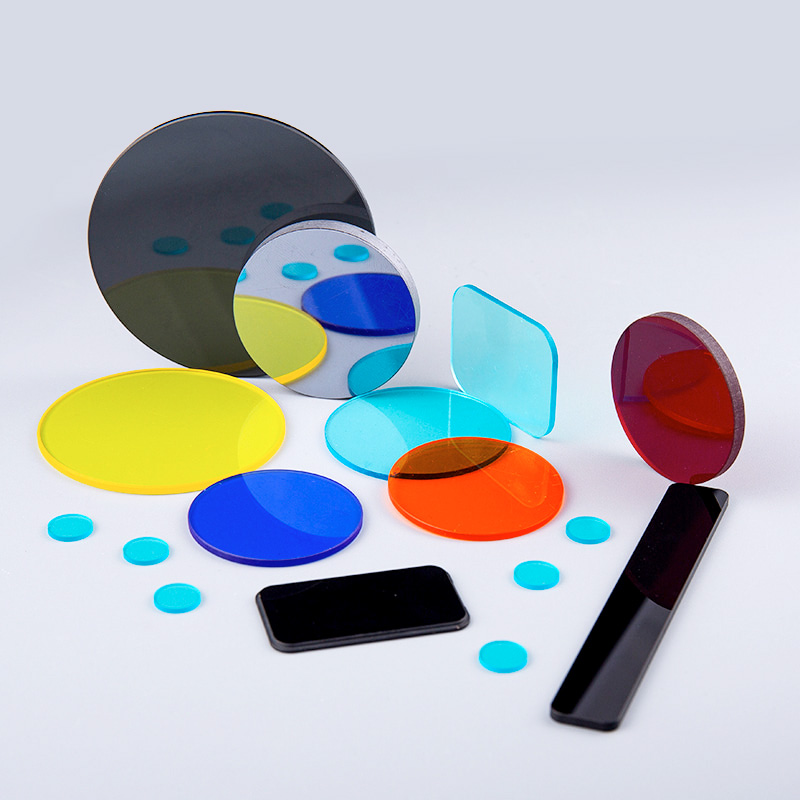
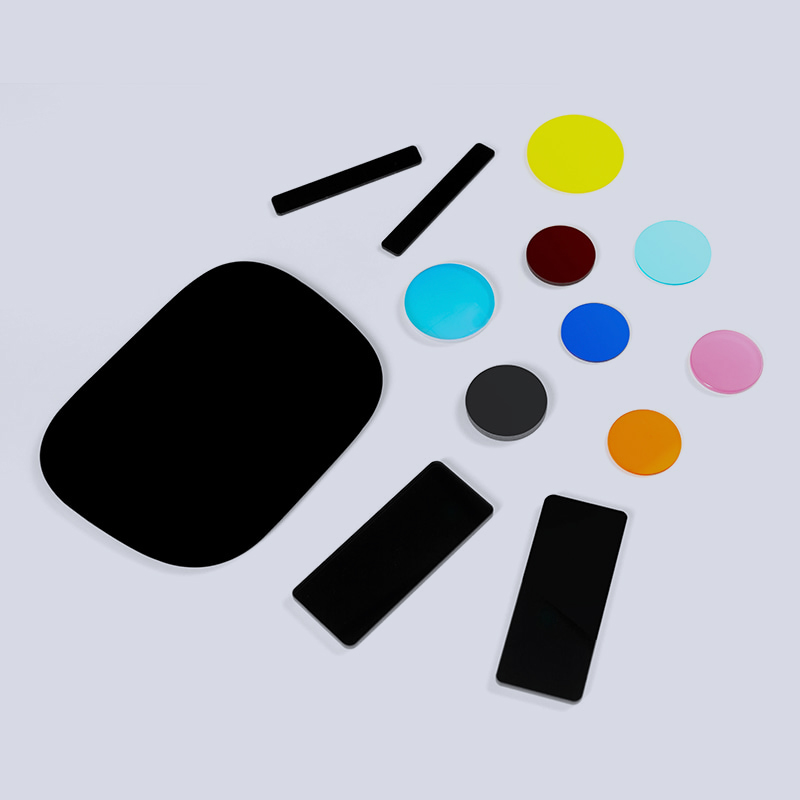
 Optical Glass Filters for Wavelength SelectionThese optical glass filters use interference coatings on glass substrates to transmit or block specific wavelengths. Located between discussions of substrate materials and filter families, they are worth reviewing to see how custom sizes, shapes, and spectral performance are supplied to drawing.View Product →
Main Filter Types and Where Each One Fits
Filter catalogs group products by spectral behavior rather than by industry, and that grouping is the right way to narrow your options. The table below summarizes the main families and their typical jobs.
| Filter type | Spectral behavior | Typical applications |
|---|---|---|
| Longpass | Transmits wavelengths longer than the cut-on point | Fluorescence emission collection, infrared sensing |
| Shortpass | Transmits wavelengths shorter than the cut-off point | UV isolation, keeping infrared away from silicon sensors |
| Bandpass | Transmits a defined band around a center wavelength | Laser line cleanup, fluorescence excitation, machine vision under colored LED lighting |
| Neutral density | Attenuates broadly and fairly evenly across a band | Exposure control, laser power adjustment, sensor testing |
| Dichroic | Reflects one band while transmitting another | Beam combining, fluorescence separation, display optics |
| UV/IR blocking | Removes ultraviolet and infrared leakage outside the working band | Outdoor imaging, photography, display inspection |
One physical detail matters more than most buyers expect: interference filters shift toward shorter wavelengths as the angle of incidence increases. A bandpass specified at 532 nm at normal incidence can drift by several nanometers at 10 to 15 degrees, enough to break a fluorescence assay. If your optics are not perfectly on-axis, state the working angle when requesting a quote so the coating can be designed around it.
The Specifications That Decide Performance
Datasheets are full of numbers, but a small set determines whether a filter works in your system. Check each of the following before comparing prices:
- Passband definition: cut-on and cut-off wavelengths for edge filters, or center wavelength and FWHM (full width at half maximum) for bandpass filters, stated in nanometers with a tolerance.
- Peak transmission: the share of light that passes the passband; quality interference filters commonly exceed 90 percent, and every point lost lengthens exposure downstream.
- Blocking depth: expressed as optical density (OD), where OD3 means 99.9 percent blocking and each additional unit multiplies attenuation by ten. Fluorescence and laser applications usually require OD4 to OD6 in the blocking band.
- Substrate: fused silica for ultraviolet work or demanding thermal stability; borosilicate or colored glass for the visible range. Thickness affects strength and transmitted wavefront error.
- Surface quality and flatness: scratch-dig values such as 40-20 or better, plus flatness in waves or fringes for imaging or interferometric paths.
- Coating durability: adhesion, abrasion, humidity, and temperature-cycle results show whether the coating survives cleaning and real operating conditions.
- Dimensions and tolerances: diameter, thickness, edge chips, and clear aperture; an undersized clear aperture quietly removes usable signal.
Finally, ask for measured transmission curves from the actual production run rather than nominal design data. The gap between a simulated curve and a measured one is where most filter disappointments live.
Glass Filters Versus Resin and Other Alternatives
Filter media divide into glass, resin or gelatin, and coated plastic, and the trade-offs are straightforward. Resin and gelatin filters are light, cheap, and easy to cut to size, but their surfaces scratch easily, they yellow under ultraviolet exposure, and their optical flatness is rarely good enough for imaging paths. Glass is harder to scratch, holds its surface figure, and stays dimensionally stable through temperature swings, which is why industrial and scientific filters are almost always glass based. The counterweights are mass, cost, and brittleness: a glass filter resists scratches but can chip or shatter if dropped or over-torqued in a mount.
For systems that are cleaned regularly, run warm, or stay in an instrument for years, glass wins clearly. For disposable or weight-critical consumer accessories, resin can be the pragmatic choice. It also helps to remember that substrate logic—ultraviolet transmission, thermal expansion, hardness—applies across the whole family of flat optical components, which is why many procurement teams specify filters and windows in the same breath.
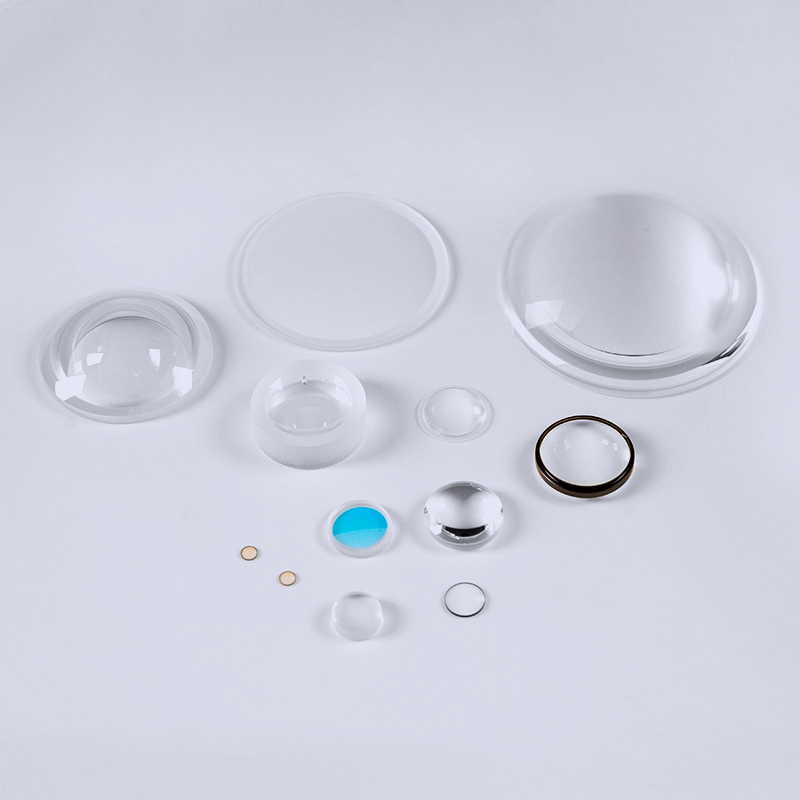
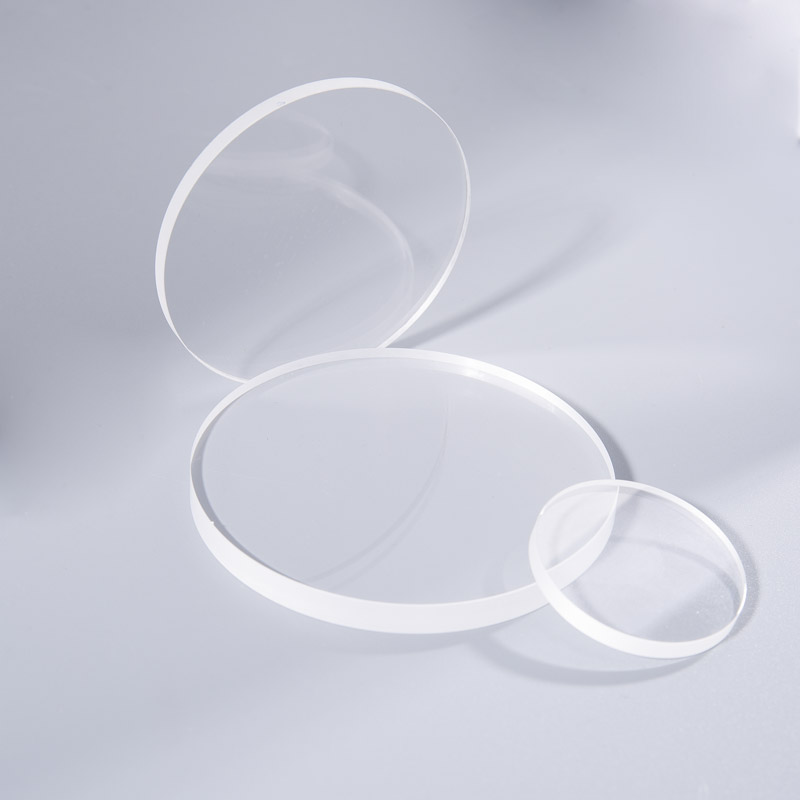 Sapphire Optical Windows for Demanding EnvironmentsSapphire windows offer high transparency plus scratch and wear resistance, protecting lasers, sensors, and optoelectronic devices. Placed amid comparisons of substrates for harsh, warm, or long-service systems, they illustrate why durable window materials matter for stable optical performance.View Product →
Where Optical Glass Filters Earn Their Place
Machine vision lines use bandpass filters matched to LED lighting to suppress ambient light and keep inspection results stable through the day. Fluorescence microscopy and medical diagnostic equipment rely on paired excitation and emission filters with deep blocking so faint signals are not drowned by excitation leakage, one of the most demanding industrial uses. Laser material processing adds line filters and protective windows that pass the working wavelength while shielding sensors and operators. Automotive systems raise the bar again: camera modules, LiDAR receivers, and head-up displays need filters that survive vibration, temperature cycling, and years of sunlight, which is why suppliers to that industry work under IATF 16949 quality management. Consumer electronics, semiconductor inspection, and security imaging round out the list.
A Practical Buying Checklist
When you move from research to procurement, the following sequence keeps a filter project on track:
- Write down the wavelengths: source spectrum, detector response, and the target band, all in nanometers. This single page drives every later decision.
- Choose the mechanism: absorptive glass for low cost and angle tolerance, or an interference coating for steep edges and deep blocking.
- Fix the numbers: transmission, OD, edge steepness, FWHM, and surface quality, each with a tolerance you can actually inspect.
- State the environment: operating temperature range, humidity, vibration, and cleaning procedure, since these decide coating selection and edge treatment.
- Demand test data: measured spectral curves, coating test reports, and inspection records for the batch you are buying.
- Run a pilot: validate the filter in your real optical path before committing to volume production.
For a longer walk-through of vendor questions and datasheet reading, the HLL team has published a practical guide to choosing optical glass filters that covers the same steps from a buyer's seat.
Working With a Filter Manufacturer
Standard catalog filters cover a great deal of ground, but many industrial projects eventually need a custom passband, an unusual size, or a coating matched to a specific source. When that happens, the information you provide determines how smoothly the project runs: spectral requirements with tolerances, substrate preference, dimensions and clear aperture, coating specification, environmental conditions, and expected volumes.
It is equally worth assessing the manufacturer itself. Look for in-house polishing and coating, spectral measurement equipment, and a quality system that matches your industry: ISO 9001 for general manufacturing, IATF 16949 for automotive programs. Changzhou Haolilai Photo-Electricity (HLL) has manufactured precision optical components since 1998, runs a 35,000-square-meter plant in the Changzhou National High-Tech District with more than 300 employees, and holds ISO 9001:2015, ISO 14001:2015, and IATF 16949 certifications, exporting to more than 20 countries. Its filters sit within a flat-optics line alongside windows, reflectors, and prisms, which simplifies sourcing when one system needs several element types.
If you already have a spectral requirement in hand, the fastest next step is to contact the HLL engineering team with your source and detector data and let them propose a substrate and coating stack.
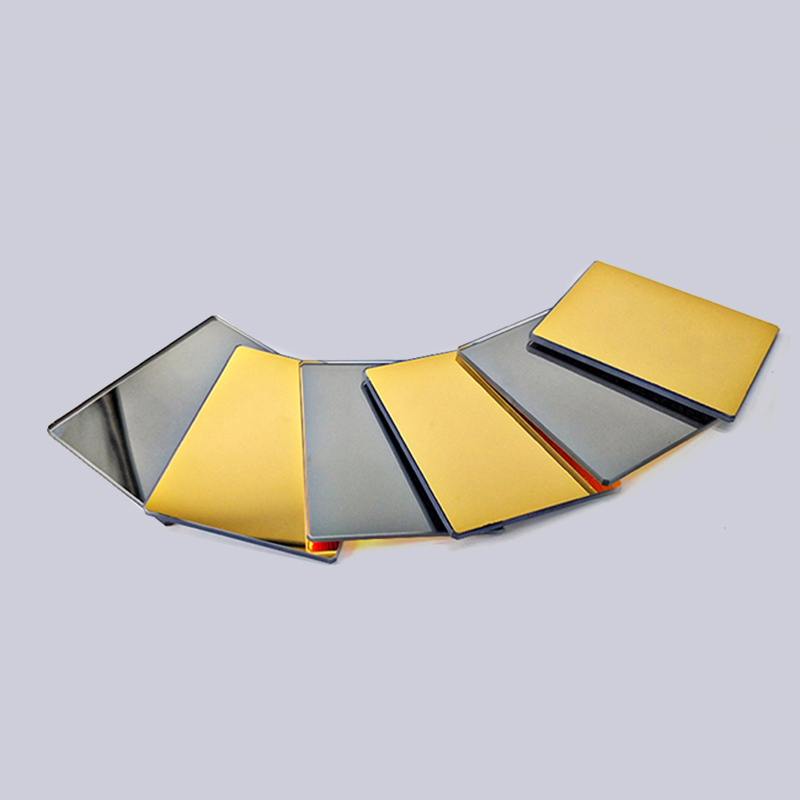
Optical Flat Mirrors for Beam Steering and AlignmentFlat mirrors reflect light at predictable angles, enabling beam control, imaging, and optical alignment. As the closing product option, they complement filters and windows as flat optical components that procurement teams often specify together for the same system.View Product →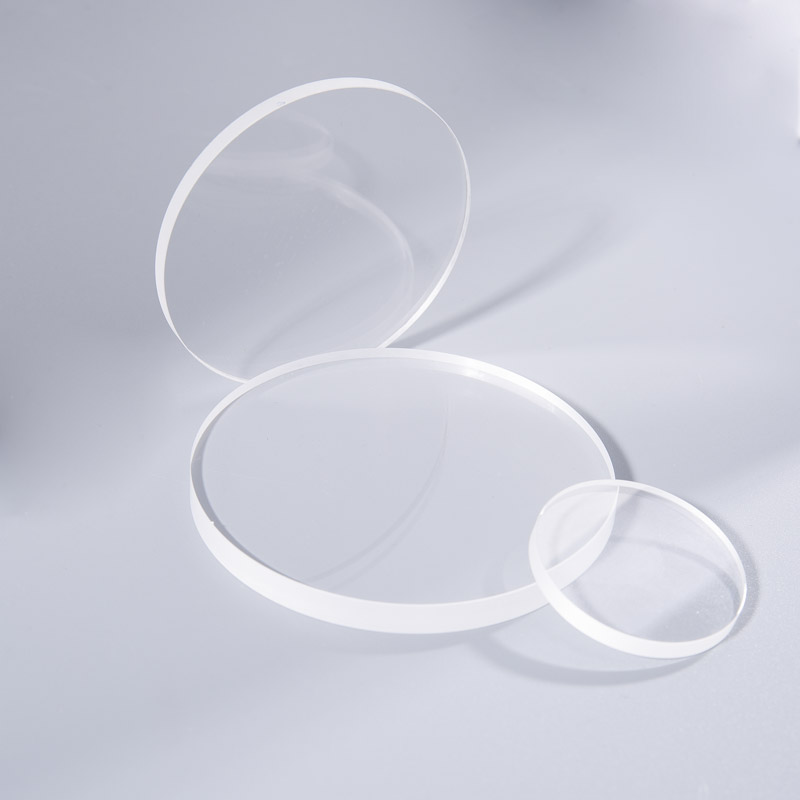

 苏公网安备32041102000130号