
 Search
 en
en English
 日本語
日本語 русский
 Español
 Deutsch
 中文简体
中文简体Content
- 1 What Are Optical Wafers
- 2 Key Material Differences Between Quartz and Glass
- 3 Side-by-Side Comparison: Quartz vs Glass Optical Wafers
- 4 Where Quartz Optical Wafers Excel
- 5 Where Glass Optical Wafers Are the Better Choice
- 6 Surface Quality and Polishing Standards
- 7 Chemical Compatibility and Cleanroom Processing
- 8 How to Choose Between Quartz and Glass for Your Optical Wafer Application
- 9 Conclusion
For most optical wafer applications, quartz outperforms standard glass. Quartz optical wafers offer superior UV transmission (down to 150 nm), a lower coefficient of thermal expansion (0.55 x 10⁻⁶/K), and higher purity, making them the preferred substrate in semiconductor lithography, deep-UV optics, and precision photonics. Glass wafers, however, remain a cost-effective and practical choice where UV transparency and thermal stability are not critical requirements.
What Are Optical Wafers
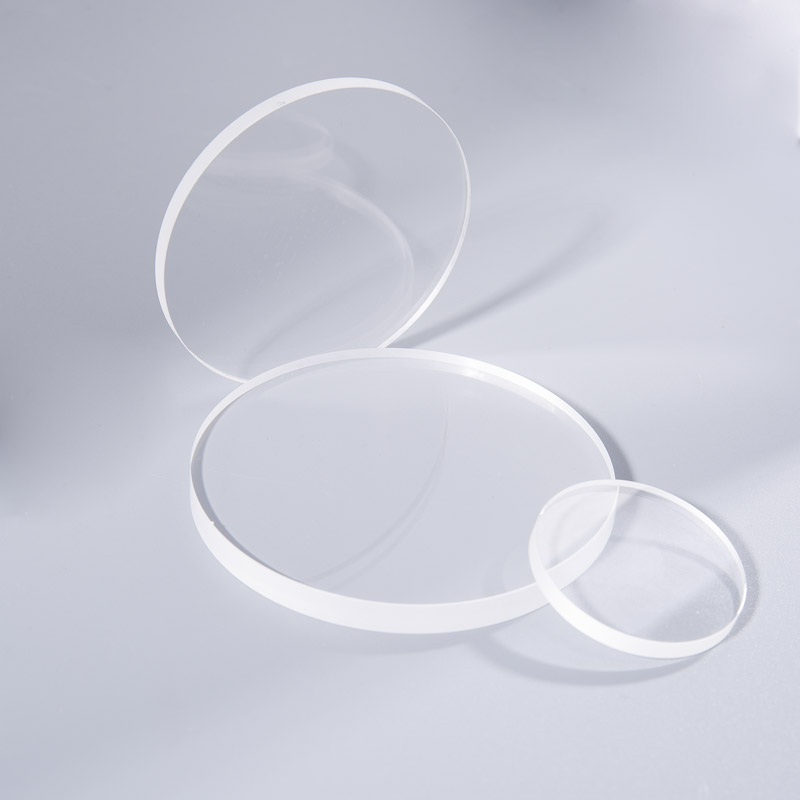
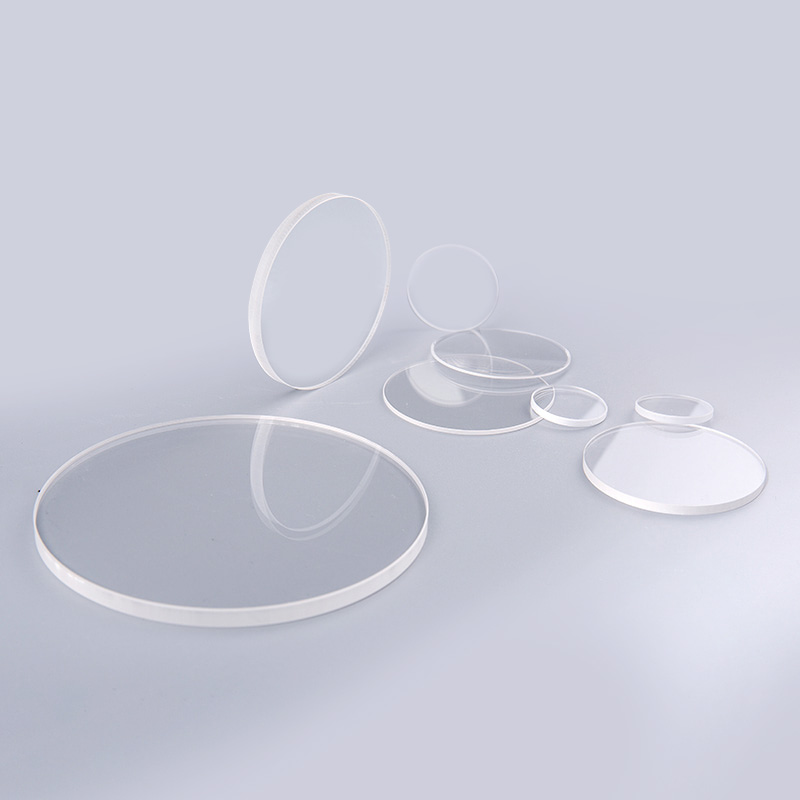
Optical wafers are thin, flat substrates fabricated to tight geometric and surface tolerances, used as the foundation for optical components, photomasks, sensors, and integrated photonic devices. They differ from electronic-grade semiconductor wafers primarily in that their optical properties, such as transmission, homogeneity, and refractive index uniformity, are as important as their mechanical properties.
The two dominant material families are quartz (fused silica or crystalline quartz) and various forms of glass (borosilicate, aluminosilicate, and soda-lime). Each carries a distinct set of optical, thermal, and mechanical characteristics that determines its suitability for a given application.
Key Material Differences Between Quartz and Glass
Understanding the structural differences between quartz and glass clarifies why they perform differently as optical wafer substrates.
Composition and Structure
Fused silica (the most common form of optical-grade quartz wafer) is composed of nearly pure silicon dioxide (SiO2) with impurity levels below 1 ppm. Crystalline quartz is also SiO2 but in an ordered lattice. Glass, by contrast, is an amorphous mixture of SiO2 with modifiers such as boron oxide (B2O3), sodium oxide (Na2O), or aluminum oxide (Al2O3), which adjust processability and cost but introduce optical and thermal trade-offs.
Optical Transmission Range
This is arguably the most important differentiator. Fused silica transmits light from approximately 150 nm (deep UV) to 3,500 nm (mid-infrared), covering a far broader spectral window than most glass types. Standard borosilicate glass typically transmits from around 300 nm to 2,500 nm, cutting off in the UV region where many photolithography and fluorescence applications operate. For 193 nm ArF excimer laser lithography or 248 nm KrF processes, fused silica is essentially mandatory.
Thermal Expansion Behavior
Thermal stability under cycling conditions determines how well a wafer maintains dimensional accuracy. Fused silica has a coefficient of thermal expansion (CTE) of approximately 0.55 x 10⁻⁶/K, compared to 3.3 x 10⁻⁶/K for borosilicate glass and up to 9 x 10⁻⁶/K for soda-lime glass. In lithographic overlay accuracy, a CTE difference of even 1 x 10⁻⁶/K across a 300 mm wafer can produce positional errors of hundreds of nanometers, which is unacceptable in advanced node fabrication.
Side-by-Side Comparison: Quartz vs Glass Optical Wafers
The table below summarizes the primary performance parameters for fused silica (quartz) versus borosilicate glass, the two most widely used optical wafer materials in practice.
| Property | Fused Silica (Quartz) | Borosilicate Glass |
|---|---|---|
| UV Transmission Cutoff | ~150 nm | ~300 nm |
| CTE (x 10-6/K) | 0.55 | 3.3 |
| Refractive Index (at 589 nm) | 1.458 | 1.472 |
| Density (g/cm3) | 2.20 | 2.23 |
| Knoop Hardness (kg/mm2) | ~615 | ~480 |
| Chemical Purity | Greater than 99.99% SiO2 | 80-85% SiO2 with modifiers |
| Relative Cost | High | Low to moderate |
| Softening Point | ~1,665 degrees C | ~820 degrees C |
Where Quartz Optical Wafers Excel
Quartz optical wafers are the substrate of choice in demanding photonic and semiconductor applications where precision and spectral range cannot be compromised.
Photolithography and Photomask Substrates
In semiconductor manufacturing, photomasks must transmit exposure wavelengths with near-zero absorption and maintain dimensional stability across thermal cycles. Fused silica is the only practical material for 193 nm immersion lithography and EUV-related pellicle and mask blank applications. A 6-inch square photomask blank made of fused silica must meet flatness specifications below 500 nm across the entire surface, a standard glass substrate cannot reliably achieve after repeated thermal exposure.
Fluorescence and Spectroscopy Instrumentation
Many biological fluorophores and analytical markers are excited in the 200 to 280 nm UV range. Quartz flow cells, cuvettes, and wafer-based microfluidic chips used in UV-Vis spectroscopy require substrates that do not absorb or autofluoresce in this range. Borosilicate glass shows significant autofluorescence when excited below 350 nm, which introduces background noise in single-molecule detection setups. Quartz reduces this background by an order of magnitude in many systems.
High-Power Laser Optics
Fused silica has a laser-induced damage threshold (LIDT) significantly higher than glass for pulsed UV lasers. For nanosecond pulse durations at 355 nm, fused silica LIDT values can reach 20 to 30 J/cm2, compared to less than 5 J/cm2 for many optical glass types. This makes quartz wafers the standard substrate for beam-shaping optics, diffraction gratings, and etalons in laser systems.
MEMS and Sensor Fabrication
Crystalline quartz, distinct from fused silica, exhibits piezoelectric properties that make it uniquely valuable in resonator and timing device fabrication. AT-cut quartz wafers are used to produce oscillators with frequency stabilities in the parts-per-billion range at room temperature, which no glass substrate can replicate due to the absence of piezoelectric response.
Where Glass Optical Wafers Are the Better Choice
Glass wafers are not simply inferior alternatives. In several application categories, they offer practical advantages that make them the more rational choice.
- Visible-light display and imaging optics: For applications operating entirely in the 400 to 700 nm visible range, borosilicate glass provides adequate transmission with far lower substrate cost. Wafer-based micro-lens arrays, color filter substrates, and backplane glass for display panels commonly use glass for this reason.
- Consumer microfluidics and lab-on-chip devices: Where UV exposure is not part of the workflow, glass microfluidic chips cost 30 to 50 percent less than equivalent quartz chips with comparable chemical resistance and surface functionalization options.
- CMOS image sensor cover glass: Thin borosilicate or aluminosilicate glass wafers serve as protective cover substrates in image sensor packages, where their lower cost and compatibility with standard dicing and bonding processes outweigh the slight UV transmission advantage of quartz.
- Prototype and low-volume optical components: For development runs where dimensional tolerances are moderate and UV performance is not tested, glass wafers substantially reduce material cost without compromising proof-of-concept validation.
Surface Quality and Polishing Standards
Both quartz and glass optical wafers are specified according to surface quality standards that govern scratch-dig ratings, surface roughness, and flatness. However, quartz and glass behave differently during polishing.
Fused silica, due to its hardness (Knoop hardness approximately 615 kg/mm2), requires longer polishing cycles to reach sub-angstrom surface roughness values (Ra less than 0.5 nm) needed for photomask and precision etalon applications. Glass, being softer, can reach comparable roughness values faster but is more prone to subsurface damage during lapping if abrasive parameters are not carefully controlled.
Scratch-dig specifications of 10-5 or better are achievable in both materials under controlled conditions, but maintaining this quality through dicing, cleaning, and coating steps is generally more reliable with quartz due to its greater hardness and chemical inertness.
Chemical Compatibility and Cleanroom Processing
In semiconductor cleanroom environments, substrate compatibility with wet chemicals, plasma processes, and high-temperature annealing steps is critical.
Fused silica is resistant to nearly all acids except hydrofluoric acid and hot phosphoric acid, and it survives thermal processes up to approximately 1,100 degrees C without deformation. Glass wafers, depending on composition, may leach alkali ions under certain wet chemical conditions, contaminating process baths or introducing unwanted dopant species near device structures. For example, soda-lime glass releases sodium ions in hot alkaline solutions, which is incompatible with standard CMOS cleaning processes.
Borosilicate glass offers substantially better chemical resistance than soda-lime glass and is used in some MEMS and microfluidics applications, but it still cannot match fused silica in high-temperature or deep UV photon-exposure environments.
How to Choose Between Quartz and Glass for Your Optical Wafer Application
Selecting the right substrate comes down to matching material properties to application requirements. The following decision criteria help narrow the choice:
- Check your wavelength range first. If any part of your process operates below 300 nm, quartz (fused silica) is required. No glass substrate provides reliable UV transmission in this range.
- Evaluate thermal cycling demands. If your wafer will experience temperature swings greater than 50 degrees C during processing or operation, the 6x lower CTE of fused silica significantly reduces thermally induced dimensional errors.
- Assess chemical exposure conditions. If the substrate will contact alkaline solutions, HF, or high-temperature acids at process temperatures above 80 degrees C, quartz offers superior resistance and ion cleanliness.
- Consider budget against volume. For applications where glass is technically sufficient, the cost savings can be 40 to 70 percent per wafer. For high-volume visible-wavelength sensors or display-related substrates, glass represents a practical engineering choice.
- Factor in piezoelectricity if needed. Only crystalline quartz provides the piezoelectric response required for resonators, oscillators, and certain MEMS transducers. Neither fused silica nor glass offers this property.
Conclusion
Quartz optical wafers are the technically superior substrate across the majority of demanding optical and photonic applications, particularly wherever UV transparency, thermal dimensional stability, high laser damage thresholds, or chemical purity are non-negotiable. Glass optical wafers remain a well-justified choice in visible-wavelength, cost-sensitive, or lower-precision applications where their performance characteristics are fully adequate. The decision is not about which material is universally better, but which properties align with the specific requirements of the application at hand.

 苏公网安备32041102000130号