
 Search
 en
en English
 日本語
日本語 русский
 Español
 Deutsch
 中文简体
中文简体Content
Pick the wrong optical filter and your entire system pays for it — degraded contrast, signal noise, or outright measurement failure. The good news is that filter selection follows a clear logic once you know where to start.
This guide cuts straight to what engineers, researchers, and procurement teams actually need: a practical framework for matching the right filter to the right job.
Start with Your Application, Not the Filter
The single most common selection error is browsing filter catalogs before defining the use case. Different applications impose fundamentally different requirements, and conflating them leads to mismatched specs.
Ask these questions first:
- What wavelength range does your light source emit, and what range does your detector actually need?
- Are you trying to isolate a signal (e.g., fluorescence emission), block interference (e.g., laser backscatter), or manage intensity (e.g., prevent sensor overexposure)?
- Is the system operating in a controlled lab environment or an industrial setting with temperature swings and vibration?
A machine vision system inspecting metallic surfaces needs glare suppression via polarizing filters. A fluorescence microscope demands narrow bandpass filters with precise center wavelengths. A day/night security camera requires switchable IR-cut filters. These are not interchangeable starting points.
Understand the Core Filter Types
There are six types that cover the vast majority of industrial and scientific applications. Each solves a specific problem.
- Bandpass filters transmit a defined wavelength window and block everything outside it. Essential in fluorescence imaging, spectroscopy, and laser line isolation. Specified by center wavelength (CWL) and bandwidth (FWHM).
- Longpass filters transmit wavelengths above a cutoff point, blocking shorter wavelengths. Common in Raman spectroscopy to reject laser excitation while passing emission signals.
- Shortpass filters do the opposite — transmitting below the cutoff. Useful for UV transmission while blocking IR heat.
- Notch filters block a narrow band while transmitting everything else. Ideal when you need to suppress a specific laser line without disturbing adjacent wavelengths.
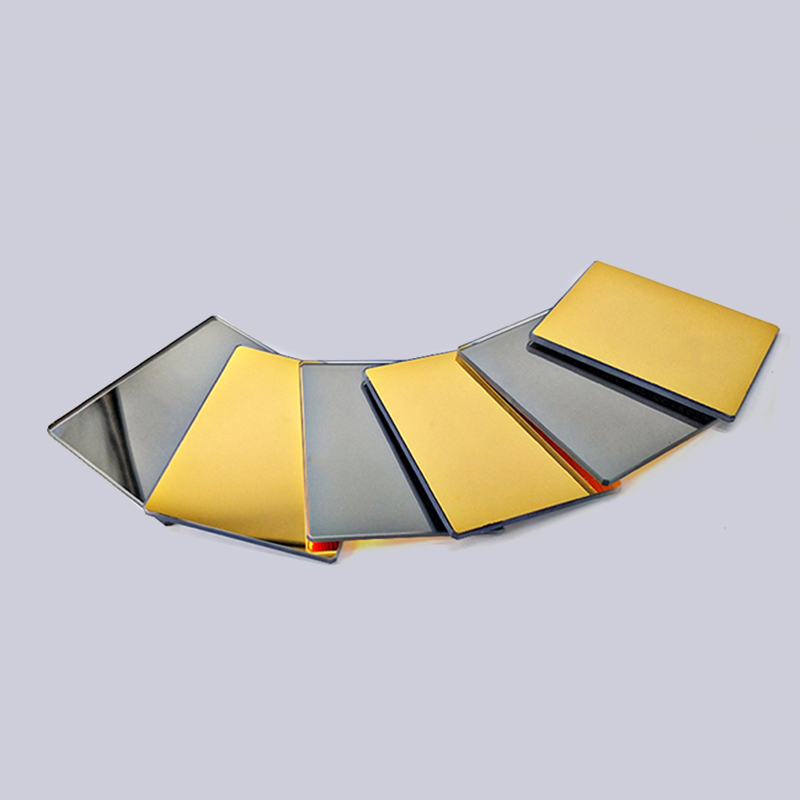
- Neutral density (ND) filters reduce overall light intensity without altering spectral distribution. Available in absorptive and reflective variants — the distinction matters at high power levels.
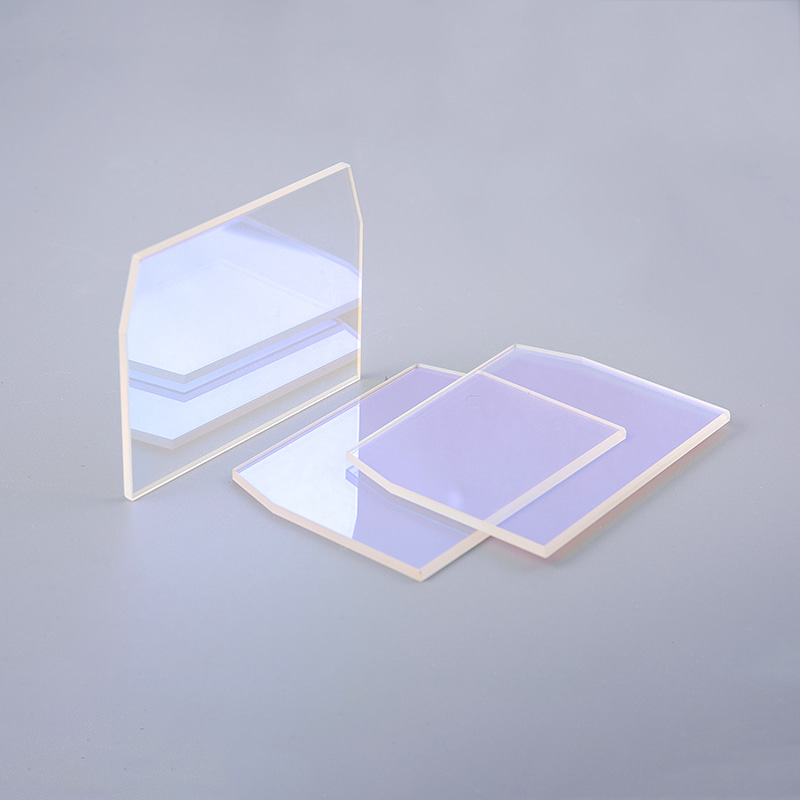
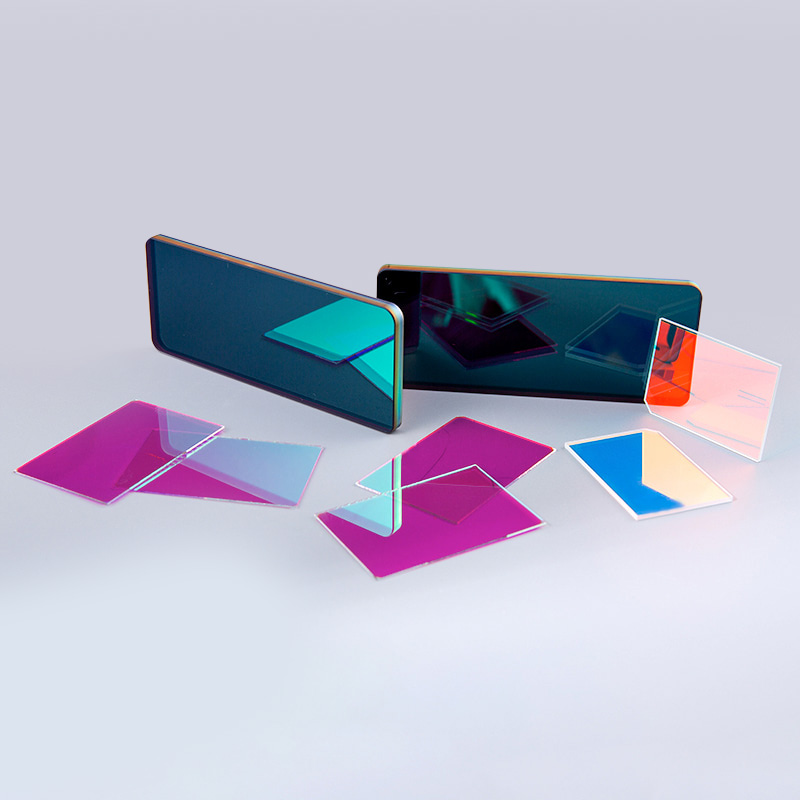
- Dichroic filters selectively reflect certain wavelengths while transmitting others, built using thin-film interference coatings for high spectral precision. These are the go-to choice for applications requiring tight wavelength control.
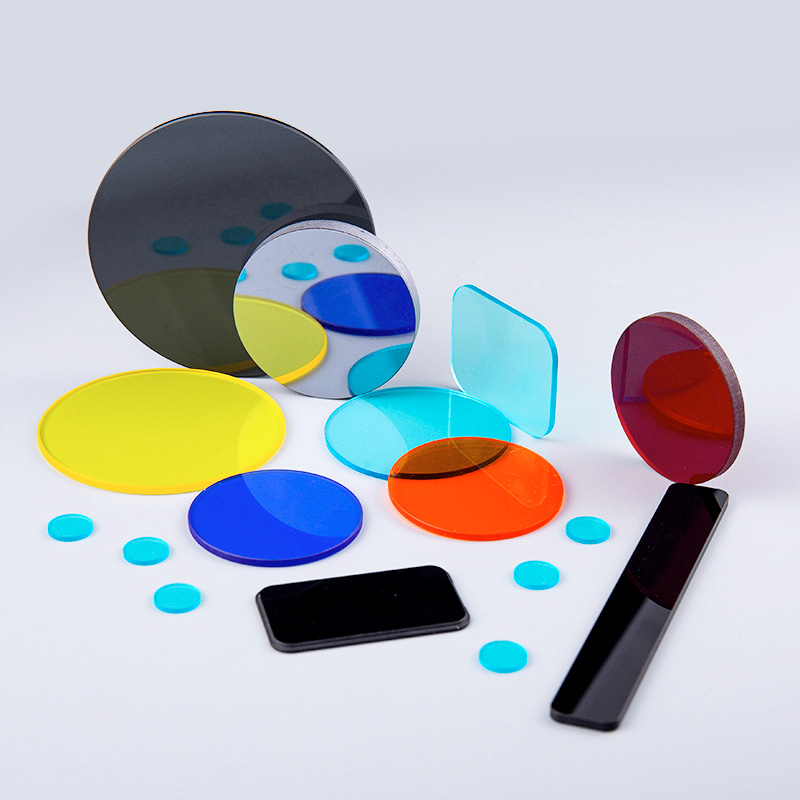
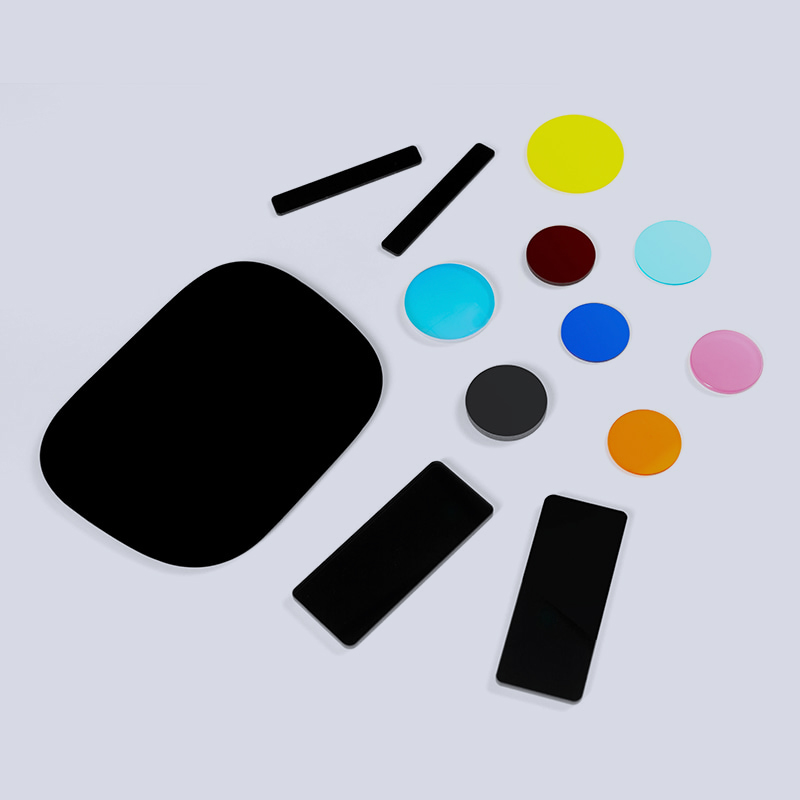
For applications requiring precise light manipulation across complex optical systems, our optical glass filters for precision light control cover a wide range of spectral requirements.
Key Specifications That Actually Matter
Filter datasheets can be dense. Here are the parameters that directly determine whether a filter performs in your system:
| Specification | What It Means | Why It Matters |
|---|---|---|
| Center Wavelength (CWL) | Midpoint of the transmission band | Must align with your light source peak or fluorophore emission |
| FWHM (Bandwidth) | Width of the passband at 50% transmission | Narrow FWHM = better signal isolation; wider FWHM = more throughput |
| Peak Transmission (%T) | Maximum light passed within the band | Low transmission wastes signal; critical in low-light applications |
| Optical Density (OD) | Degree of out-of-band blocking | OD 4–6 required for demanding applications like laser safety or fluorescence |
| Angle of Incidence (AOI) | Angle at which light hits the filter surface | Dichroic filters shift toward shorter wavelengths as AOI increases |
Surface quality standards — scratch-dig ratings per MIL-PRF-13830B or ISO 10110-7 — also determine whether a filter holds up under repeated use. For high-power laser applications, a rating of 40-20 or better per industry surface quality standards is typically required.
For a deeper look at how these specifications interact in real systems, see our article on how optical glass filters enhance light control in precision optics.
Match Filter to Environment
A filter that performs perfectly on the bench can fail in the field if the operating environment wasn't factored into the selection.
Temperature is a primary concern for thin-film interference filters. As temperature rises or falls, the dielectric coating layers expand or contract, shifting the transmission spectrum — sometimes by several nanometers. Hard-coated (sputtered) filters offer better thermal stability than traditional soft-coated laminated designs.
Laser power density determines whether you need an absorptive or reflective ND filter. Absorptive filters convert blocked light into heat; at high irradiance, this leads to thermal damage. Reflective ND filters redirect the energy away from the optic, making them the safer choice for high-power systems.
Humidity and chemical exposure degrade soft coatings over time. For harsh industrial environments, specify filters with hard oxide coatings that meet MIL-C-48497A adhesion and abrasion requirements.
Substrate material also plays a role. Fused silica handles UV wavelengths and high temperatures better than standard BK7 glass, while germanium or silicon substrates are necessary for mid- and far-infrared applications.
Common Selection Mistakes to Avoid
Even experienced engineers make these errors. Catching them early saves significant rework.
- Ignoring angle of incidence. Dichroic filters are highly angle-sensitive. A filter designed for normal incidence (0°) will shift its transmission band when light arrives at even 10–15°. Always verify AOI compatibility with your optical layout before ordering.
- Focusing only on peak transmission, not blocking depth. A filter with 95% peak transmission but only OD 2 out-of-band blocking may allow enough stray light to corrupt your measurement. Match the OD rating to your signal-to-noise requirements.
- Using absorptive filters in high-power systems. Absorptive glass filters are stable, low-cost, and angle-insensitive — but they absorb rather than reflect blocked light. In laser or intense illumination setups, thermal buildup causes cracking or coating failure. Use reflective or hard-coated interference filters instead.
- Skipping the transition region. Cut-on and cut-off wavelengths are never perfectly sharp. There is always a transition slope — the steeper the better for edge filters. Verify that your target wavelengths sit clearly within the pass band, not in the transition zone.
- Overlooking substrate flatness. In systems where the filter is used in a converging or diverging beam, poor substrate flatness introduces wavefront error that degrades image quality. Specify flatness in waves (e.g., λ/4 or better) when used near a focus.
For a comprehensive overview of filter types and real-world selection scenarios, our practical guide to optical glass filters — types, selection, and applications covers additional use cases in detail.

 苏公网安备32041102000130号