
 Search
 en
en English
 日本語
日本語 русский
 Español
 Deutsch
 中文简体
中文简体Content
- 1 What Optical Glass Filters Actually Do — and Why It Matters
- 2 Types of Optical Glass Filters and Their Spectral Functions
- 3 The Physics of Light Control: How Filters Shape Transmission Profiles
- 4 Key Performance Parameters Engineers Must Specify
- 5 Precision Optics Applications Where Filter Performance Is System-Critical
- 6 Substrate Material and Coating Process: The Foundation of Filter Quality
- 7 Integrating Filters into Precision Optical Systems: Design Considerations
What Optical Glass Filters Actually Do — and Why It Matters
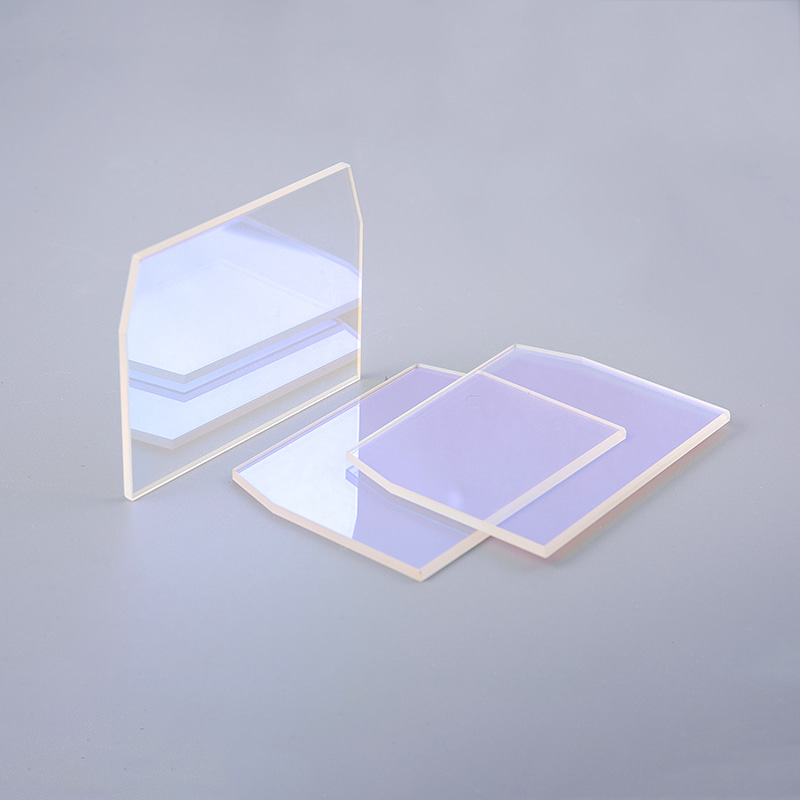
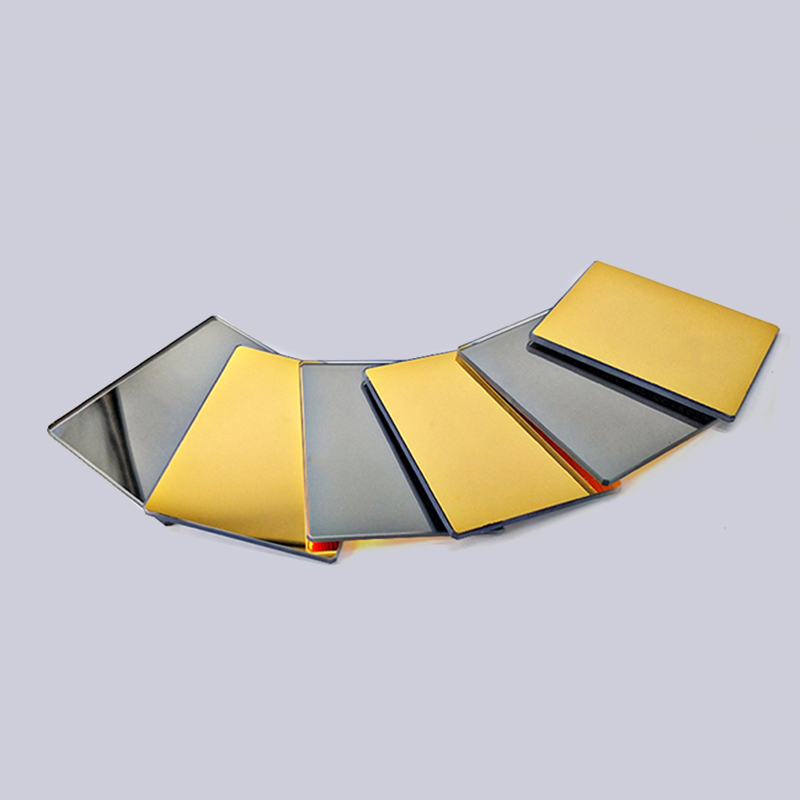
Optical glass filters are wavelength-selective transmission components placed in the optical path to pass, attenuate, or block specific bands of light. In precision optics, their role is not decorative — they are load-bearing elements of the system's performance. Whether the application is fluorescence microscopy, hyperspectral imaging, industrial machine vision, or laser-based metrology, the filter's spectral and physical characteristics directly determine what information the detector receives.
The core principle is simple: different wavelengths carry different information. A raw light beam entering a sensor without spectral control produces noise, cross-talk, and ambiguity. Filters eliminate that ambiguity by enforcing strict boundaries on what passes through. In high-sensitivity imaging systems, a well-specified bandpass filter can improve signal-to-noise ratio by an order of magnitude compared to unfiltered detection.
Understanding filter function requires distinguishing between the two dominant mechanisms: absorption and interference. Absorption-based filters — typically colored optical glass — use the bulk material itself to attenuate unwanted wavelengths through selective molecular absorption. Interference filters, by contrast, use precisely deposited thin-film stacks to exploit constructive and destructive interference, achieving transmission profiles that absorption glass simply cannot match in sharpness or customization.
Types of Optical Glass Filters and Their Spectral Functions
Precision optics applications rely on several distinct filter categories, each engineered for a different control task:
- Bandpass filters transmit a defined wavelength window (the passband) while rejecting energy above and below. The key parameters are center wavelength (CWL) and full-width at half maximum (FWHM). Narrowband bandpass filters used in astronomy or Raman spectroscopy may have FWHM values as tight as 0.1 nm.
- Longpass (LP) filters transmit all wavelengths above a specified cut-on wavelength and block everything below. They are widely used to reject laser excitation light in fluorescence imaging, allowing only the longer-wavelength emission signal through to the detector.
- Shortpass (SP) filters perform the inverse — transmitting shorter wavelengths and blocking longer ones. Common in systems that must eliminate infrared contamination from visible-band detectors.
- Neutral density (ND) filters attenuate light uniformly across a broad spectrum without altering the spectral distribution. Optical density (OD) values range from OD 0.3 (50% transmission) to OD 6.0 (0.0001%), enabling precise exposure and power control.
- Notch filters (also called band-rejection or band-stop filters) block a narrow band of wavelengths while transmitting everything else. Their primary application is laser line suppression in Raman and fluorescence spectroscopy, where laser scatter would otherwise overwhelm the weak Raman signal.
- Dichroic filters separate light by reflecting one spectral band and transmitting another, enabling simultaneous multi-channel detection in systems like confocal microscopes and multi-photon imaging platforms.
| Filter Type | Primary Function | Typical Application |
|---|---|---|
| Bandpass | Isolate target wavelength band | Fluorescence microscopy, spectroscopy |
| Longpass | Block short wavelengths | Emission detection, laser rejection |
| Shortpass | Block long wavelengths | IR rejection, visible-band sensing |
| Neutral Density | Uniform broadband attenuation | Laser power control, exposure calibration |
| Notch | Suppress specific wavelength line | Raman spectroscopy, laser safety |
| Dichroic | Reflect one band, transmit another | Multi-channel microscopy, projection systems |
The Physics of Light Control: How Filters Shape Transmission Profiles
The spectral performance of an optical glass filter is governed by two physical mechanisms: bulk absorption in colored glass substrates, and thin-film interference in hard-coated filters.
Absorption-Based Glass Filters
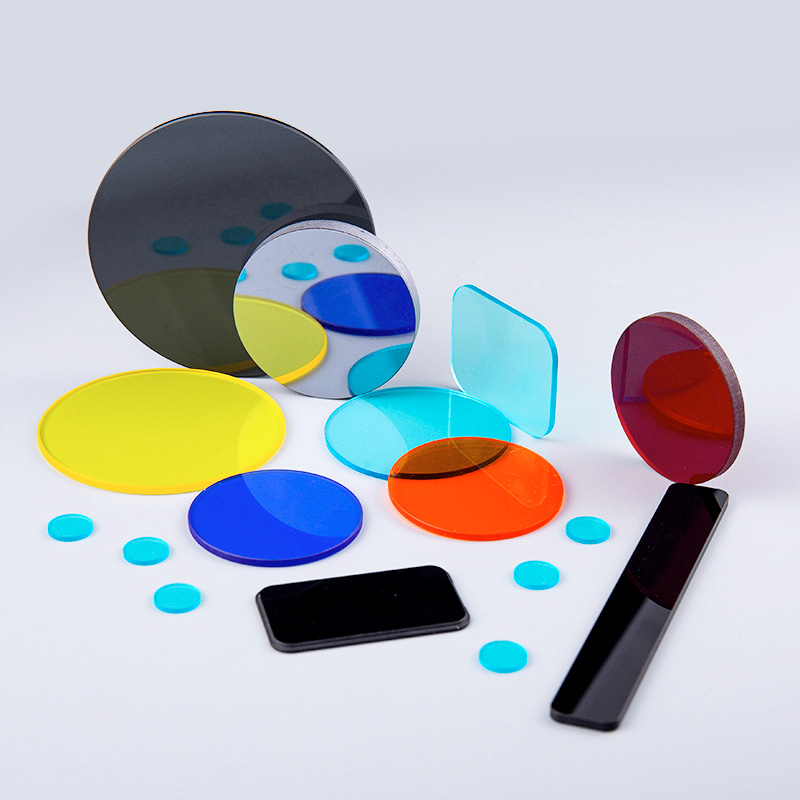
Colored optical glass achieves wavelength selectivity through rare earth or transition metal ion doping. For example, didymium glass absorbs sodium yellow light (~589 nm), making it standard in glassblowing eye protection and certain colorimetric reference applications. The absorption profile is determined by the electronic transitions of the dopant ions and follows Beer-Lambert attenuation. These filters are robust, temperature-stable, and cost-effective — but their transition slopes are gradual and their blocking depth is limited compared to interference designs.
Thin-Film Interference Filters
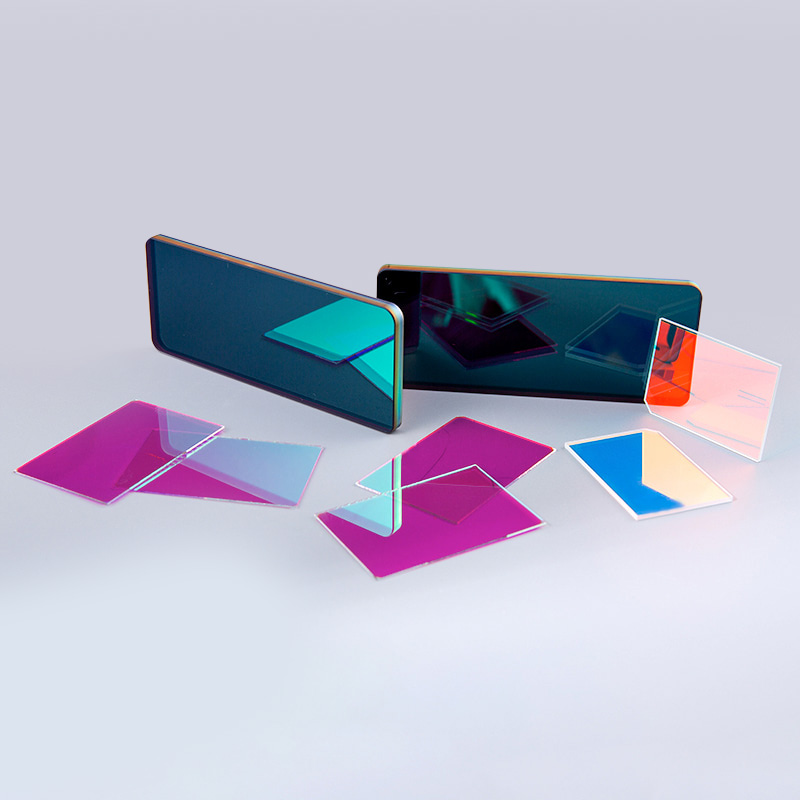
Modern precision interference filters are built by depositing alternating layers of high- and low-refractive-index dielectric materials (typically TiO₂/SiO₂ or Ta₂O₅/SiO₂) onto polished optical glass substrates using physical vapor deposition (PVD) or ion-assisted deposition (IAD). Each layer is typically a quarter-wavelength thick at the design wavelength. The total coating stack can comprise 50 to over 300 individual layers, with each layer's thickness controlled to sub-nanometer precision.
Constructive interference reinforces transmission at target wavelengths; destructive interference produces the blocking. This mechanism enables performance characteristics that absorption glass cannot achieve: edge steepness better than 2 nm, out-of-band optical density exceeding OD 6.0, and custom passband placement anywhere from deep UV to mid-infrared.
One critical consideration is angular sensitivity. Interference filters are designed for a specific angle of incidence (typically 0°). Tilting the filter blue-shifts the passband — a shift that follows the relationship: λ(θ) = λ₀ × √(1 − sin²θ / n_eff²). In convergent or divergent beam geometries, this effect must be accounted for in system design, either by specifying cone-angle-corrected filters or by placing the filter in a collimated portion of the optical path.
Key Performance Parameters Engineers Must Specify
Selecting the wrong filter specification is one of the most common sources of system underperformance in precision optical instruments. The following parameters are non-negotiable in any rigorous specification process:
- Center Wavelength (CWL) and tolerance: For narrowband filters, CWL tolerance of ±1 nm or tighter is routinely achievable and often required in spectroscopy or multi-laser fluorescence systems.
- FWHM (Bandwidth): The spectral width at 50% of peak transmission. Narrower FWHM improves spectral selectivity but reduces throughput — a direct trade-off that must be balanced against detector sensitivity.
- Peak Transmission (Tpeak): High-performance bandpass filters can achieve Tpeak > 95% in the passband. Low transmission wastes photons and forces longer exposure times or higher illumination power.
- Blocking depth (OD): Defines how much out-of-band light is rejected. Fluorescence applications often require OD ≥ 5.0 to prevent laser excitation light from overwhelming the emission signal.
- Blocking range: The spectral range over which the specified OD is maintained. A filter that achieves OD 6 only at the laser line but leaks at 200 nm away is insufficient for broadband-illuminated fluorescence systems.
- Surface quality and flatness: Precision imaging applications require surface flatness ≤ λ/4 per inch to avoid wavefront distortion. Surface quality is specified per MIL-PRF-13830 (e.g., 20-10 scratch-dig) for demanding applications.
- Temperature and humidity stability: Optical coatings must maintain performance across the operating environment. Hard-coated IAD filters typically pass MIL-C-48497 and MIL-E-12397 environmental qualification tests.
Precision Optics Applications Where Filter Performance Is System-Critical
The impact of optical glass filter selection becomes most visible in application domains where photon budgets are tight, spectral cross-talk is intolerable, or measurement accuracy is traceable to filter specification.
Fluorescence Microscopy and Flow Cytometry
Multi-color fluorescence experiments use matched sets of excitation filters, dichroic beamsplitters, and emission filters. A poorly chosen emission filter that allows 0.01% laser leakage can generate a background signal 100× brighter than a dim fluorescent label. Filter sets for instruments like confocal laser scanning microscopes are optimized to simultaneously maximize label-specific emission transmission and minimize spectral bleed-through between channels.
Raman and LIBS Spectroscopy
Raman scattering is an inherently weak phenomenon — Raman photons may be 10⁻⁷ times less intense than the Rayleigh-scattered excitation light. Holographic notch filters and ultra-steep longpass edge filters (with OD > 6 at the laser line and >90% transmission within 5 cm⁻¹ of it) are essential to make the Raman signal detectable. Without the correct filter, the laser scatter simply saturates the detector.
Machine Vision and Hyperspectral Imaging
Industrial inspection systems using structured illumination or narrowband LED sources pair their light sources with matched bandpass filters to reject ambient light interference. In food safety hyperspectral cameras, narrowband filters isolating specific near-infrared absorption bands allow detection of contaminants or moisture content at parts-per-million sensitivity levels.
Astronomy and Remote Sensing
Solar observation telescopes use ultra-narrowband hydrogen-alpha filters (FWHM ≈ 0.3–0.7 Å) to isolate solar chromosphere emission from the overwhelming photospheric continuum. Earth observation satellites incorporate multi-band filter wheels or integrated filter arrays to capture vegetation indices, atmospheric constituents, and surface mineralogy from discrete spectral channels.
Substrate Material and Coating Process: The Foundation of Filter Quality
The optical glass substrate is not a passive carrier — its refractive index homogeneity, surface finish, and bulk transmission directly affect filter performance. Common substrate materials include:
- Fused silica (SiO₂): Broadband transmission from ~180 nm to ~2.5 µm, extremely low thermal expansion (CTE ≈ 0.55 × 10⁻⁶/K), ideal for UV and deep-UV applications and environments with thermal cycling.
- Borosilicate glass (e.g., Schott BK7, N-BK7): Excellent visible transmission, good polishability, widely used for visible-range interference filters where UV performance is not required.
- Calcium fluoride (CaF₂) and barium fluoride (BaF₂): Used for mid-IR and VUV filter substrates where standard oxide glass is opaque. CaF₂ transmits to ~10 µm, BaF₂ to ~12 µm.
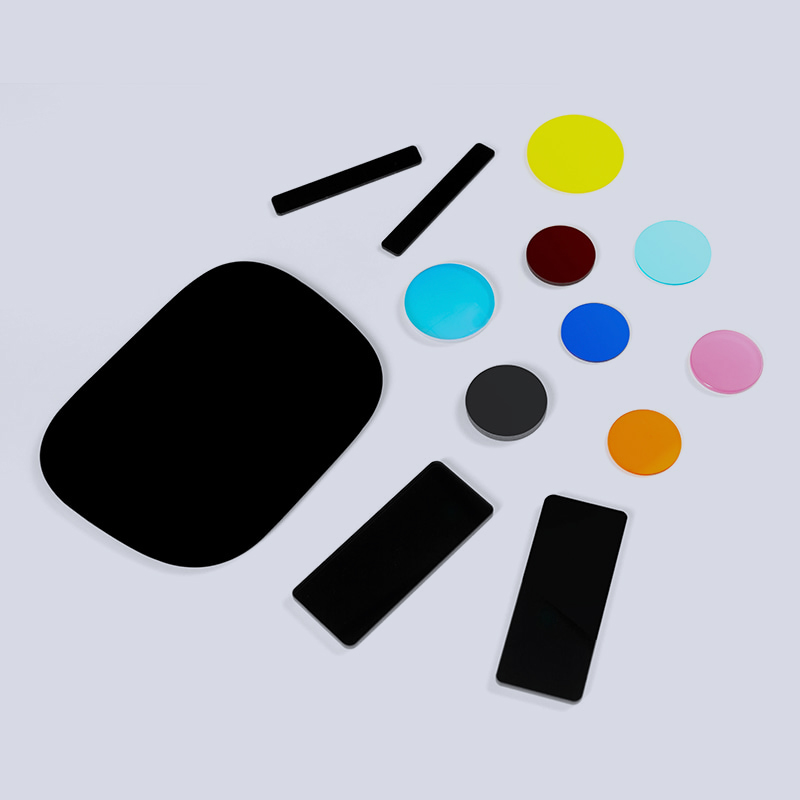
- Colored optical glass (e.g., Schott RG, OG, BG series): Used in absorption-type filters for longpass, shortpass, and broad bandpass functions without coatings.
Coating quality is equally critical. Ion-assisted deposition (IAD) produces denser, harder coatings with better environmental stability than conventional evaporation. Magnetron sputtering offers the highest packing density and best batch-to-batch repeatability for volume production of precision filters. The deposition process determines not only optical performance but also coating adhesion, abrasion resistance, and long-term stability under UV irradiation and humidity cycling.
Integrating Filters into Precision Optical Systems: Design Considerations
Optical glass filters do not operate in isolation. Their integration into a system introduces considerations that must be addressed at the design stage to avoid performance degradation:
- Beam collimation: Placing interference filters in collimated sections of the optical path avoids cone-angle-induced passband shifts and maintains the specified spectral profile across the full aperture.
- Thermal management: Filters in high-power laser paths must account for coating absorption heating. Even OD 6 blocking regions may absorb enough energy to induce thermal lensing or coating damage if power density exceeds design limits. Damage threshold specifications (in J/cm² for pulsed, W/cm² for CW) must be verified against the laser parameters.
- Ghost reflections: Both surfaces of a filter reflect a fraction of incident light. Anti-reflection (AR) coatings on the substrate surfaces reduce these reflections, typically to <0.5% per surface in the passband. In interferometric systems, even small ghost reflections can introduce fringe artifacts.
- Polarization effects: Interference filter performance can vary with polarization state, particularly at non-normal angles of incidence. For polarization-sensitive applications, this must be measured and, if necessary, compensated in the system design.
- Cleanliness and handling: Coated filter surfaces are sensitive to fingerprints and particulate contamination. Contamination absorbs energy in high-power applications and scatters light in imaging systems. Proper storage in nitrogen-purged containers and handling with clean-room gloves are standard practice.

 苏公网安备32041102000130号