
 Search
 en
 English
 日本語
 русский
 Español
 Deutsch
 中文简体
Content
- 1 What an Optical Prism Does to a Beam
- 2 The Main Prism Types and the Job Each One Performs
- 3 Material and Coating Choices That Decide Performance
- 4 Specifications to Verify Before You Approve a Drawing
- 5 Where Prisms Fail After Delivery
- 6 Sourcing Custom Prisms Without Losing the Tolerance
- 7 Frequently Asked Questions
A buyer sends out an RFQ for 500 right-angle prisms: 20 mm legs, N-BK7 glass, a 90-degree beam turn, and almost nothing else on the drawing. Three quotes come back within a week and land 40 percent apart. The gap is rarely the glass. It is the angle tolerance, the number of coated faces, the chamfer specification and whether the hypotenuse is polished for total internal reflection or simply left ground.
Prisms behave politely in a classroom demonstration and unforgivingly in a real assembly. A 30-arcsecond angular error looks harmless on an inspection certificate and turns into a visible spot shift once the beam travels another 600 mm through the system. That is the whole reason this component deserves a specification conversation rather than a price comparison.
What an Optical Prism Does to a Beam
An optical prism is a transparent solid with flat, polished faces that changes the direction, path or spectral content of light through refraction, total internal reflection or both.
Three mechanisms do nearly all the work, and each one places a different demand on the part.
- Refraction. Light bends at every air-glass interface. Deviation depends on the apex angle and the refractive index, so angle tolerance and index tolerance stack on top of each other.
- Dispersion. The index shifts with wavelength, which is why blue light leaves a dispersing prism at a wider angle than red. Essential in spectroscopy, unwanted in an imaging path where it shows up as colour fringing.
- Total internal reflection. Light meeting a glass-air boundary beyond the critical angle reflects with very high efficiency and needs no coating. The catch is that a fingerprint, a dust film or a fine scratch on that face quietly converts reflection into scatter.
Working definition: a prism redirects or separates light through flat polished faces. If the part works through a curved surface, it is a lens, and the drawing, the metrology and the price structure all change with that single difference.
The Main Prism Types and the Job Each One Performs
Prism type follows the light path you need, so the shape should be chosen last and the function first.
| Right-angle prism | Bends a beam 90 degrees by total internal reflection or a mirrored hypotenuse | Periscopes, camera finders, beam folding on compact benches | Whether the hypotenuse is polished for TIR or coated |
| Dove prism | Rotates an image without inverting it | Image rotation in spinning mounts, interferometers | Length-to-aperture ratio and rotation-axis alignment |
| Penta prism | Holds a constant 90-degree deviation even when the prism tilts | Alignment tools, rangefinders, surveying optics | Deviation tolerance rather than a single angle figure |
| Roof prism | Inverts the image while folding the optical path | Binoculars, spotting scopes | Roof edge quality and whether phase coating is required |
| Equilateral dispersing prism | Separates white light into its wavelength components | Spectroscopy, wavelength selection, teaching benches | Apex angle, material dispersion, surface flatness |
| Wedge prism | Steers a beam by a small fixed angle | Beam steering, line generators, path correction | Wedge angle and the direction of deviation |
| Polarising beamsplitter cube | Splits light by polarisation state | Laser optics, interferometry, microscopy | Extinction ratio and cement layer quality |
Two prisms can look identical and still be specified in completely different languages. A right-angle prism used as a folding mirror is judged on deviation angle and transmitted wavefront; the same cube used as a dispersing element is judged on apex angle, index homogeneity and internal stress.
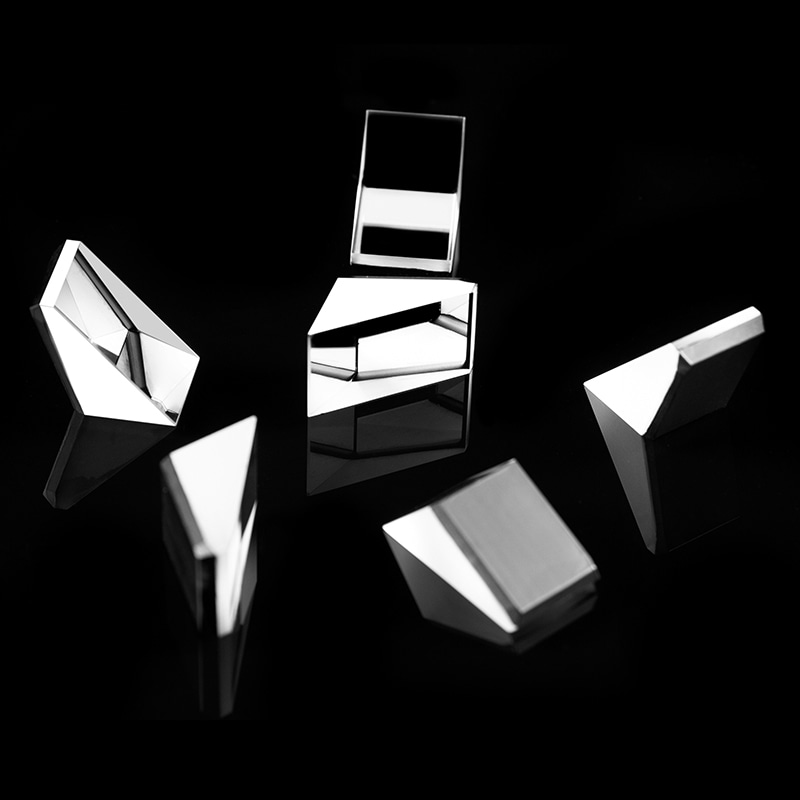 Optical Prisms and Light Guide BlocksBrowse general optical prisms and light guide blocks, with prism angle, refractive index and material considerations relevant to comparing right-angle and penta prism behavior.View Product →
Material and Coating Choices That Decide Performance
Material and coating choices set transmission, thermal stability and service life, and they move the quotation more than most buyers expect at first review.
N-BK7
The default for visible and near-infrared work. Good homogeneity, wide availability and moderate cost, with an index around 1.517 at 587 nm.
Fused silica
Lower thermal expansion and useful UV transmission. Preferred for high-power laser paths and for instruments where a 40 degrees C swing must not move the beam.
Every uncoated air-glass surface loses roughly 4 percent of light at normal incidence, so a four-face prism without coating can shed more than 15 percent before the beam reaches the sensor. Broadband anti-reflection coatings cut that to well under 1 percent per face, but they multiply the risk: adhesion, humidity resistance and laser damage threshold now have to be specified and tested surface by surface.
Specifications to Verify Before You Approve a Drawing
Seven specifications decide whether a prism works in your assembly, and five of them are usually missing from the first drawing revision.
State the angle, the tolerance in arcminutes or arcseconds, and which face the measurement starts from.
Flatness in fringes for each face; wavefront error for cemented cubes and beamsplitters.
Scratch-dig applies per surface. The hypotenuse of a TIR prism usually deserves a tighter grade than the entry face.
Chamfer width and the maximum permitted chip size protect both handling yield and coating yield.
Reflection target, angle of incidence range, wavelength band, adhesion test method and damage threshold where relevant.
Index homogeneity, bubble and inclusion class, and internal stress for polarisation-sensitive paths.
Humidity exposure, thermal cycling and which solvents the end user will clean the optic with.
An angle tolerance without a stated reference face is an unfinished specification. Two suppliers can both deliver 10 arcseconds and still ship parts that will not interchange, because they measured from different surfaces with different fixtures.
Where Prisms Fail After Delivery
Most field failures on prisms trace back to coating adhesion, edge chips or contamination on a total-internal-reflection face rather than to the bulk glass.
- Coating adhesion loss after cleaning, usually linked to solvent choice or wipe technique.
- Edge chips that appear after ultrasonic cleaning, because the chamfer was never written into the drawing.
- Cement layer degradation in beamsplitter cubes exposed to humidity or short-wavelength light.
- Thermal drift where an aluminium housing and a glass prism expand at different rates.
- Contamination on the TIR hypotenuse, which converts reflection into scatter without any visible damage.
A 0.2 mm chip inside the clear aperture of a small prism removes far more light than the same chip on the rim of a 50 mm window. Chamfer and edge chip limits belong in the RFQ, not in the post-delivery conversation.
The wording matters as much as the numbers, and our prism buying checklist walks through the clauses worth copying into a purchase order.
Sourcing Custom Prisms Without Losing the Tolerance
The supplier question that matters is not price per piece, but whether the vendor can hold the angle tolerance across the whole lot and prove it with data.
Changzhou Haolilai Photo-Electricity (HLL) has produced precision optics since 1998 from a 35,000 square metre site in the Changzhou National High-Tech Zone, with more than 300 staff, ISO 9001:2015, ISO 14001:2015 and IATF 16949 certification, a provincial precision optical lens engineering centre, and exports to more than 20 countries. Its prism line sits alongside lenses, windows, mirrors and wafers, so a prism and its neighbouring optics can be quoted against one tolerance stack.
Before approving a sample, request a first article report that names the angle measurement method, a coating curve for every coated face, an adhesion test record, and a sampling plan that covers each production lot rather than one hand-picked part.
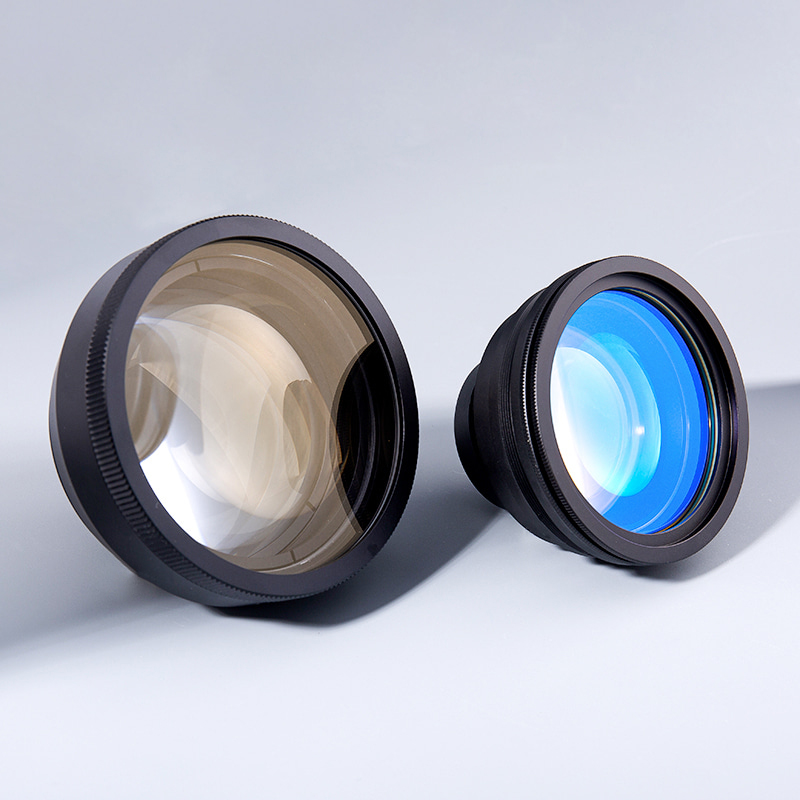 Custom Optical Lenses and Lens ComponentsReview custom optical lens options across shapes and sizes, with specification details useful when preparing sample approvals and RFQ requirements.View Product →
Put the reference face, the measurement method and the sampling plan into the RFQ. Those three lines prevent more disputes than any price negotiation that follows them.
Drawings and tolerance questions can be sent through the contact page; a pdf with the reference face marked is worth more than three emails of description.
Frequently Asked Questions
How is an optical prism different from a plain glass block?
A prism is defined by its specification, not its outline. Optical prisms carry flatness and angle tolerances in arcminutes or arcseconds, a graded material with controlled bubbles and stress, defined surface quality per face, and usually a coating. A glass block with the same dimensions has none of those.
What angle tolerance should I request?
Start from the system error budget, not from a catalogue page. Imaging and illumination paths are usually comfortable at 30 arcseconds to 1 arcminute, while interferometry and beam-steering assemblies often need a few arcseconds. Always name the reference face and the measurement method.
Which glass suits a visible-light prism?
N-BK7 covers most visible and near-infrared work at moderate cost. Choose fused silica for deep UV transmission, high-power laser paths or wide temperature swings, and sapphire where infrared transmission or abrasion resistance dominates.
Should coating come before or after cementing?
Internal faces must be coated before cementing, which means coating yield and cement yield are separate risks that stack. Design the cube so that critical coatings sit on external faces where possible, and confirm the cement cures without stressing the coated surfaces.
Prism cost follows tolerance, not size. Fix the function, state the reference face and specify coating per surface, and the next set of quotes will finally be comparable.

 苏公网安备32041102000130号