
 Search
 en
en English
 日本語
日本語 русский
 Español
 Deutsch
 中文简体
中文简体Content
Two prisms can leave the same polishing line with identical drawings and still behave differently inside a finished instrument. The glass is rarely the reason. Angle tolerance, the figure of the polished faces, and the way the coating survives the real beam decide whether the part holds alignment for years or drifts out of spec within months.
An optical prism is a transparent solid bounded by flat, polished surfaces that meet at defined angles. Light entering one face is refracted at the glass-air boundary, travels through the material, and then either refracts again at the exit face or reflects internally, so a beam can be deviated, dispersed, rotated or folded inside a very small volume.
Optical prism definition: a solid transparent element with at least two flat polished surfaces, used to deviate, disperse, rotate or reflect light through controlled refraction and total internal reflection.
In practical systems that single definition covers five different jobs, and each job pushes a different specification to the front of the drawing:
- Deviating a beam by a fixed angle, most often 90 or 180 degrees
- Dispersing white light into separate wavelengths for measurement
- Folding a long optical path into a short mechanical envelope
- Rotating or inverting an image without adding lenses
- Splitting, combining or sampling a beam for monitoring
How an Optical Prism Bends Light
A prism bends light because glass has a higher refractive index than air, so the beam changes direction at every polished surface it crosses.
The size of that change follows Snell's law, applied twice: once at entry, once at exit. Total deviation depends on the apex angle of the prism, the refractive index of the material, and the wavelength of the light. Because index rises as wavelength shortens, blue light deviates more than red light, and the beam leaving the prism spreads into a spectrum. Every dispersing prism, from a classroom demonstration piece to a spectrometer's front end, works on that principle.
Total internal reflection gives prisms a second role. In N-BK7 the critical angle sits at about 41.2 degrees, so light striking an internal 45 degree face reflects with almost no loss and without any metal coating. A right-angle prism used this way replaces a mirror, removes the risk of coating degradation, and keeps the reflected beam at a fixed position relative to the entrance face.
A 60 degree equilateral prism in N-BK7 produces a minimum deviation of roughly 38.7 degrees at 587.6 nm. Shift the apex angle by one arcminute and the exit beam shifts with it, which is why prism drawings quote angles in arcminutes and arcseconds rather than in millimetres.
Types of Optical Prisms and What Each One Does
Most prism orders fall into seven standard geometries, and each one is governed by a different controlling specification.
| Prism type | Optical action | Typical application | Specification to control |
| Right-angle prism | Deviates the beam 90 degrees by internal reflection, or 180 degrees when used in pairs | Periscopes, viewfinders, beam steering | Angle between the two legs and flatness of the hypotenuse |
| Porro prism | Two internal reflections, 180 degree deviation, image erection | Binoculars, observation instruments | Matched pair angle tolerance |
| Roof prism | 90 degree deviation with image erection along a roof edge | Compact telescopes, cameras | Roof angle error in arcseconds and roof edge chip limit |
| Dove prism | Rotates the image at twice the mechanical rotation rate | Alignment telescopes, interferometers | End face parallelism and length to aperture ratio |
| Pellin-Broca prism | 90 degree constant deviation at one selected wavelength | Spectroscopy, wavelength selection | Apex angle and material dispersion |
| Equilateral dispersing prism | Separates wavelengths by refraction | Spectrometry, laser tuning, teaching optics | Apex angle, glass homogeneity, surface quality |
| Wedge prism | Small, controlled beam deviation | Beam steering, optical correction | Wedge angle in arcminutes |
Geometry is only half of the specification. The same right-angle prism can be supplied with polished or fine-ground legs, with or without an anti-reflective coating, and with angle tolerances that differ by an order of magnitude between a general grade and a precision grade.
Where a design uses several prisms in series, the tolerances compound rather than average out. A pair of Porro prisms that are each acceptable on their own can still produce a tilted or rotated image when they are mounted together.
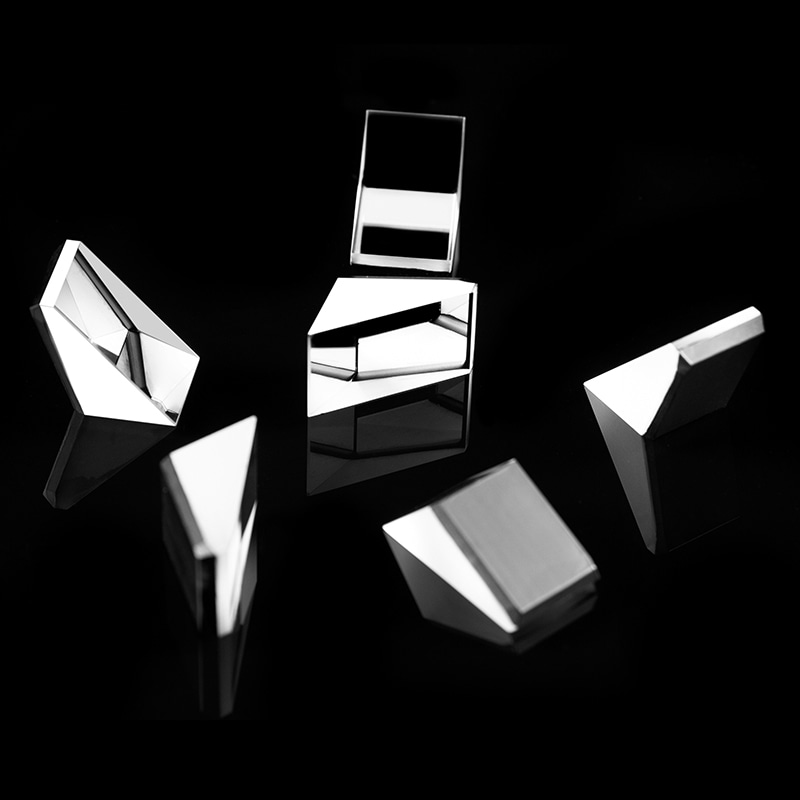 Optical Prism Range for Custom Light Direction and DispersionExplore optical prisms and light guide blocks for directing, reflecting, or dispersing light in spectrometers, microscopes, telescopes, displays and aberration correction.View Product →
Specifications Buyers Should Verify Before Ordering
Five specifications decide whether a prism works in a system: angle tolerance, surface flatness, surface quality, clear aperture and coating performance. Everything else on the drawing is secondary to those five.
| Specification | Typical range | What happens if it is wrong |
| Angle tolerance | 3 arcminutes general, 30 arcseconds precision, 5 arcseconds high precision | Beam pointing error that no mount adjustment can fully correct |
| Surface flatness | Quarter wave to one tenth wave at 632.8 nm | Wavefront distortion, enlarged spot size, lost resolution |
| Surface quality | 60-40 scratch-dig general, 20-10 for laser use | Scatter, coating defects, reduced damage threshold |
| Clear aperture | 80 to 90 percent of the face dimension | Vignetting and beam clipping at the edges |
| Chamfer | 0.2 to 0.5 mm at 45 degrees | Edge chipping that becomes a permanent scatter source |
| Coating | Anti-reflective below 0.5 percent per surface | Ghost reflections, throughput loss, coating failure under power |
A 30 arcsecond angle error displaces the beam by about 0.15 mm after one metre of travel. Multiply that across the surfaces in a folding train and it stops being an abstract tolerance and becomes a visible alignment problem on the test bench.
Incoming inspection is the cheapest place to catch those errors. A short, repeatable sequence catches nearly everything that reaches a production line:
- Match the material certificate and index grade to the drawing before any measurement begins.
- Measure angle on a goniometer or autocollimator while the part is still in its protective wrap.
- Check surface figure with an interferometer across the full clear aperture, not only at the centre.
- Verify coating transmission or reflectance at the design wavelength and confirm the damage threshold for pulsed beams.
- Record dimensions, chamfer and lot traceability in the inspection log so a later failure can be traced to a batch.
A fuller version of this checklist, written for procurement and design teams, is set out in our guide to choosing a custom optical prism.
Materials and Coatings That Change Performance
N-BK7 remains the default prism material for visible and near-infrared work; fused silica, sapphire and high-index glasses take over when thermal stability, transmission range or dispersion matter more than cost.
Coating changes performance as much as the substrate does, and the trade-off is usually decided by beam power rather than by cost alone.
Uncoated prism
- Fresnel reflection of roughly 4 percent per surface in N-BK7
- Lowest unit cost and the shortest lead time
- No coating layer to degrade or burn
- Acceptable for illumination, viewing and low-power demonstration work
Anti-reflective coated prism
- Reflection below 0.5 percent for a single layer, below 0.2 percent for broadband designs
- Higher throughput across multi-prism assemblies
- Reduced ghost images and stray light
- Damage threshold must be specified for pulsed laser use
For pulsed lasers, coating damage threshold matters more than transmission. Losing four percent of the energy is easy to accept; a coating that fails at the fluence your beam delivers ends the light path permanently.
Where Optical Prisms Are Used
Optical prisms appear wherever a beam has to be folded, split or stabilised inside limited space, and the same part often serves industries that look unrelated on paper.
- Medical imaging and endoscopy, where prism assemblies fold the image path inside tubes only a few millimetres wide
- Automotive sensing and LiDAR, where prisms steer and split beams without any moving parts
- Spectroscopy and laser tuning, where dispersing prisms separate wavelengths for measurement
- Binoculars, telescopes and periscopes, where Porro, roof and Dove prisms erect and rotate images
- Laser beam folding on machine tools, where a coated right-angle prism keeps the beam path short
- Machine vision and interferometry, where flatness and angle stability drive measurement accuracy
Inside a medical endoscope, the prism assembly has to fold the optical path by 90 degrees within a housing measured in millimetres. Edge quality and mounting geometry end up mattering almost as much as the optical figure, because a chipped corner at that scale throws scatter straight into the image.
Prisms are rarely used alone. They are normally paired with lenses that do the focusing while the prism handles direction, dispersion or orientation, so a single assembly often needs both components specified against the same alignment budget.
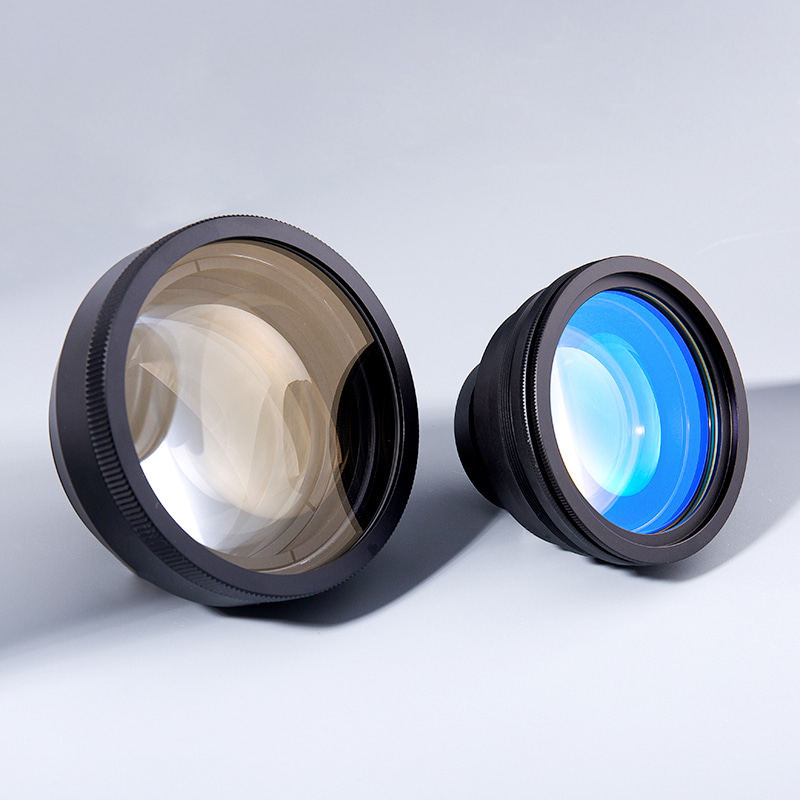 Optical Lens Range for Focusing, Collimating, and Custom ApplicationsBrowse optical lenses from plano-convex to complex non-spherical types for security, measurement, consumer electronics, laser systems, and custom automotive applications.View Product →
What to Send With a Prism RFQ
A prism quotation is only as accurate as the drawing attached to it. Suppliers price against the tolerance stack, not against the shape, so an incomplete drawing produces either a padded price or a part that fails on arrival.
Optical specification
- Material and index grade
- Apex angle with tolerance
- Surface flatness at the test wavelength
- Scratch-dig surface quality
- Clear aperture as a percentage of face
- Coating curve and required reflectance or transmission
Mechanical specification
- Outer dimensions with tolerances
- Chamfer size and angle
- Mounting faces and reference edges
- Orientation marks for assembly
- Weight limit for airborne or handheld builds
Commercial information
- Prototype and production quantities
- Inspection report level required
- Packaging and cleanroom handling needs
- Delivery schedule and destination
- Lot traceability requirements
Prototype and production prices for the same prism often differ by 30 percent or more per piece. Tooling, blocking fixtures and coating runs are amortised across different quantities, so quoting each stage separately gives a clearer picture than a single blended figure.
Send the drawing together with the operating wavelength and the beam power to our engineering team and the tolerance review can usually be completed alongside the quotation, rather than after the first parts arrive.
Frequently Asked Questions About Optical Prisms
What is the difference between an optical prism and a lens?
A lens has curved surfaces and forms an image by converging or diverging light. A prism has flat polished surfaces and changes the direction, dispersion or orientation of light without forming an image by itself. The two are frequently combined in one assembly: the prism folds and orients the path, the lens does the focusing.
How tight should prism angle tolerance be?
Work backwards from the system budget. General illumination and viewing instruments usually tolerate a few arcminutes. Imaging, metrology and interferometry normally need 30 arcseconds or better. A prism sitting inside a multi-element assembly that must stay aligned over temperature may need 5 arcseconds, and the mount design has to support that.
Which material should I choose for a prism?
N-BK7 covers most visible and near-infrared work at moderate temperature. Fused silica suits deep ultraviolet transmission, thermal stability and higher laser damage resistance. Sapphire handles harsh environments and infrared bands at the cost of harder processing. A high-index glass such as N-SF11 gives a larger deviation from a smaller apex angle, which keeps dispersing prisms compact.
Can custom prisms be produced in small quantities?
Yes. Prototype runs of a few pieces are routine, and the limiting factors are usually coating batch sizes and the tooling needed to block and polish an unusual geometry. Supplying a complete drawing with tolerances at the first enquiry shortens the path from quote to first article.
Ask for the inspection report before you argue about the price. A cheap prism that fails first-article inspection costs more in lost programme time than a correctly specified one ever will.

 苏公网安备32041102000130号