
 Search
 en
en English
 日本語
日本語 русский
 Español
 Deutsch
 中文简体
中文简体Content
A quotation for an "optical spherical mirror" can vary five-fold between two suppliers, and the reason is rarely the glass itself. It's the tolerances hiding behind the price.
What Buyers Actually Need to Specify
Before requesting a quote, four parameters determine whether the mirror you receive will actually work in your system. Skip any one of them and you're leaving the outcome to the factory's default settings.
| Parameter | What it controls | Typical range |
|---|---|---|
| Surface figure accuracy | Wavefront distortion, focus quality | λ/4 to λ/10 @ 633nm |
| Scratch-dig | Stray light, laser damage resistance | 60-40 (commercial) to 10-5 (laser-grade) |
| Diameter tolerance | Fit inside mounts and barrels | +0.00/-0.05mm typical |
| Radius of curvature tolerance | Focal length accuracy, imaging position | ±0.1% to ±0.5% |
An optical spherical mirror quoted without these four numbers written down is essentially a blank check. Ask the supplier to confirm each one in writing, not just "standard quality," which means something different at every factory.
Concave or Convex: Matching the Curve to the Application
The geometry decision comes before the coating decision. Concave mirrors, reflecting off the inner surface of the sphere, converge parallel light toward a focal point. That property makes them the default choice for solar collectors, projection systems, and any setup where light needs to be gathered and concentrated.
Convex mirrors do the opposite. They spread the reflected beam and deliver a wider field of view from a compact surface. This is why they show up in vehicle side mirrors, store surveillance mirrors, and safety mirrors at blind intersections — anywhere the priority is coverage over magnification.
Mixing the two up isn't a minor spec error. A convex mirror substituted where a concave one was needed simply won't form the intended image, regardless of how tight the surface figure is. For auto optics and laser optics applications, the curve type should be the first line item confirmed with the supplier, before diameter or coating discussions even start.
Coating Choices That Affect Cost and Performance
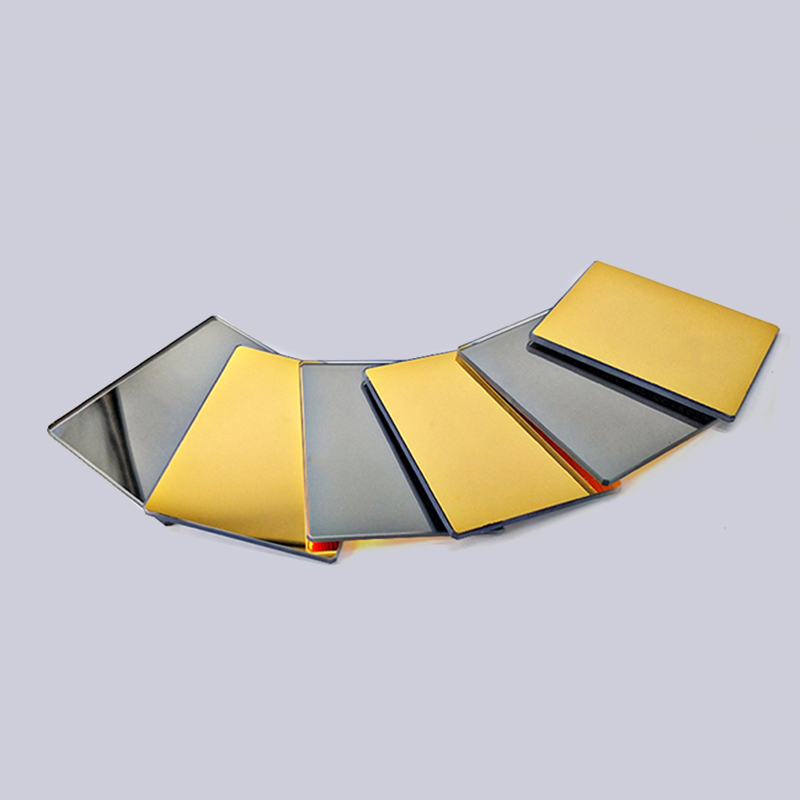
Aluminum coatings are the economical default, offering broadband reflectivity from visible through near-IR at roughly 88-92% reflectance. They suit general-purpose imaging and low-cost assemblies where a few percent of light loss is acceptable.
Silver coatings push reflectance above 96% across visible and IR wavelengths, but the surface is softer and needs a protective overcoat to resist tarnishing and handling damage. Dielectric coatings are the premium option: reflectance above 99% at a targeted wavelength band, with excellent damage threshold for laser applications, at a correspondingly higher unit price.
When a quote comes back cheaper than expected, the coating spec is usually where the corner was cut. Confirm the reflectance percentage and the wavelength band it's measured at, not just the coating material name.
What to Verify Before You Commit to a Supplier
Specifications on paper mean little if the factory can't hold them consistently across a production run. Three things are worth confirming before placing a first order:
- Quality system certifications relevant to your industry — ISO9001 for general manufacturing, IATF16949 specifically for automotive supply chains, ISO14001 for environmental compliance
- precision optics testing and quality control capability — interferometry for surface figure, spectrophotometry for coating performance, and whether inspection reports are provided per batch
- Sample-to-production consistency — request a small trial batch and measure part-to-part variation before committing to volume
A supplier that hesitates to share test data or certification documents at this stage is telling you something about how the rest of the relationship will go.
Sourcing From an Established Manufacturer
Changzhou Haolilai Photo-Electricity Scientific and Technical Co., Ltd. (HLL) has manufactured precision optical components since 1998 from a 35,000m² facility in Changzhou, Jiangsu, holding ISO9001:2015, ISO14001:2015, and IATF16949 certification. The company operates the Jiangsu Precision Optical Lens Engineering Technology Center and holds multiple invention and utility model patents, with production focused on laser optics, auto optics, semiconductor optics, and consumer optics.
For buyers who need documented specifications and consistent batch quality rather than a best-guess quote, that combination of certification and in-house engineering capacity is worth checking against any shortlist.

 苏公网安备32041102000130号